Recipes, Beef Recipes

Ox Heart with Flatbread, Tahini Dressing & Pickled Chillies

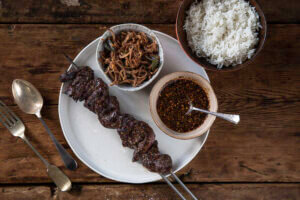
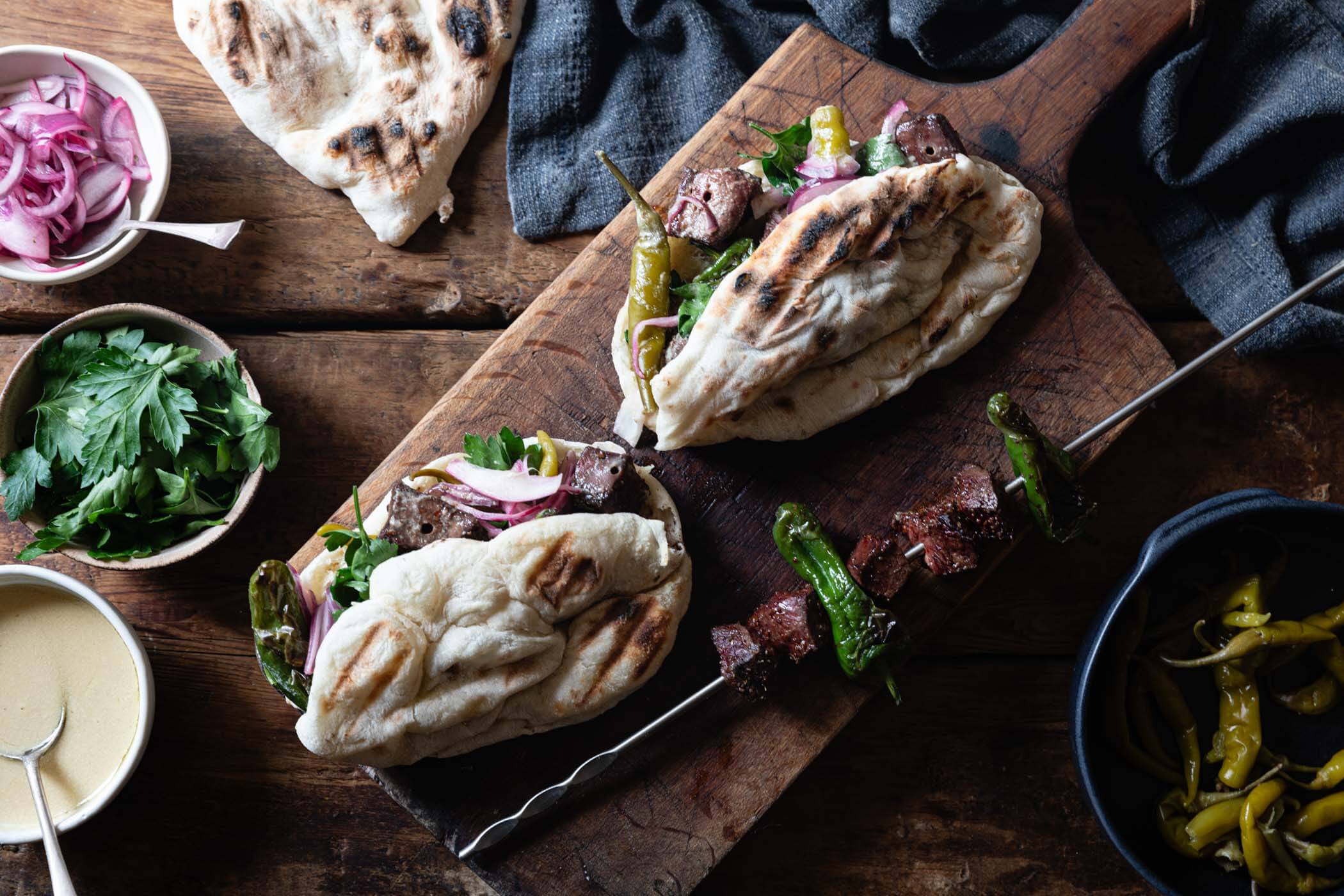
My ox heart recipe is a fantastic ensemble for barbecue season, with a nod to the flavours of the Levant. Let your guests build them as they please.

Skewered meat, for me, carries a certain level of excitement and intrigue. Perhaps it’s because it isn’t a particularly common practice in traditional British food culture, though it’s certainly gaining ground as we continue to benefit from the richness of multiculturalism and a more expansive culinary landscape. Or perhaps I’m overthinking it, and it’s simply the result of living for many years in northeast London, close to some of the finest ocakbaşı establishments in the country. Watching the masters at work, flipping skewers and bread behind a screen of charcoal smoke, is endlessly inspiring.

Whatever the reason, and really it doesn’t matter, I love cooking food on skewers.

One final note: a freshly baked piece of bread, whatever its shape, is always a thing of beauty. These flatbreads certainly live up to that. Joy!

Serves: 6

Prep time: 30 minutes, (dough, heart, dressing), plus overnight proving (8–12 hours)

Cook time: 35 minutes

Ingredients

Tahini Dressing

Flatbread

Method

To Make the Flatbread Dough

  1. Add all the ingredients to the bowl of your stand mixer, attach the dough hook and mix on a low speed for 5-minutes, then turn the speed up to medium and mix for a further 5-minutes, then finally 2 more minutes on a low speed.
  2. Or if making by hand; bring together all the ingredients until combined then knead on a lightly-floured surface for 15-minutes.
  3. Tip the dough onto a lightly-floured surface and shape into a ball, trying to create tension in the dough as you go. Lightly flour the inside of the bowl and place the dough ball into the bowl. Cover with a damp cloth and leave out of the fridge overnight.
  4. The following morning, tip the dough back onto a lightly-floured surface and cut into 125g pieces then shape into balls, again creating tension in the dough.
  5. Lightly oil a large tray and lay the shaped dough balls onto the tray, with a little space in between. Cover again with a damp cloth and leave to prove for up to 8-hours, or until you are ready to bake them.

Now for the Tahini Dressing

  1. Put the tahini, garlic, lemon juice, water and a pinch of salt into a food processor or blender and blitz for 30-seconds, then, whilst blitzing, begin emulsifying in the oils, slowly.
  2. Taste for seasoning and adjust as necessary using salt and more lemon juice if needed to find a good balance.

Prep the Ox Heart

  1. Using a sharp knife, remove the hard fat from the outside of the heart and remove the top of the heart, where the arteries are.
  2. Then open out the heart and remove the sinew from the inside, break the heart down into smaller pieces to make this easier.
  3. A whole ox heart is likely to be too much for this recipe, so take some of it and freeze for a later date. Then dice the remaining heart into 1-2cm pieces.
  4. Lightly toast the cumin and coriander seeds then add to a pestle and mortar with the Aleppo pepper flakes, coarsely grind and then add a good pinch or two of salt.
  5. Season the diced heart with the spice mix and a little drizzle of oil. Toss together so all the heart is coated.
  6. Load the heart onto the skewers, with Padrón peppers interspersed throughout.

Assemble the Dish

  1. Light the barbecue and wait for the charcoal to burn white.
  2. Place the red onions into a bowl and season with salt, mix well and then add the juice of a lemon and leave to sit for 20-minutes.
  3. Lay the heart skewers on the barbecue, where the heat is hot but not too fierce and cook for around 8-minutes, turning regularly. Once cooked, remove and leave to rest.
  4. Take a ball of dough and lay on a floured surface and flatten out with your hand, pushing outwards from the centre.
  5. Take the flattened dough and lay on the barbecue. Cook for 1-minute on each side and then flip as needed until the bread is cooked and nicely coloured.
  6. Repeat these steps till all the bread is cooked.
  7. Make an incision in the side of the bread and open it up. Wrap around the skewered meat and pull off into the bun. Dress with tahini dressing, then add the red onions, pickled chillis and picked parsley.
  8. Eat and enjoy.

Order meat online

Instagram

  • Winter and its cold hands have us fully in a tight embrace right now. And so we find ourselves cooking more often than not, to warm our souls.

A ham at the weekend is one such thing that does the job. It can be used for all kinds of dishes and provide your weekdays with a plethora of fine sandwiches. But this fine cut also produces something else. An excellent, warming stock that should not be thrown away.

In fact, it should be used to make something just as special. A deep, hearty split pea and ham soup. And here is @grylos showing you how to do it. Like most things, if you cook with time and consideration, the by-product is often just as good as the main event.
  • Ask yourself this. When did you last have a really good pork chop?

This is why we keep coming back to it. Native, rare breed pork. Dry aged on the bone. Proper depth of flavour. Nothing like the pale, wet stuff you see elsewhere.

These are our Pork Chops with Rosemary and Anchovy Butter. Two thick, rindless chops. Two discs of handmade compound butter. Anchovy, rosemary, lemon zest, a little shallot. Old friends. It works.
  • Fancy a bit of a butcher’s tip? Or a hack, if you will. Well look no further. 

Here, @grylos, gets creative with a joint of boned and rolled beef rump, creating three, totally different meals, from the one piece of meat. A great example of some leftfield thinking and the perfect way to add a little variety into your weekly meal planning. Along the spectrum from raw to medium, your week could go a little something like this; tartare and toast lightly rubbed with garlic for lunch on Wednesday; steak night on Friday night, with chips, good red wine and a bowl of bearnaise; a roast dinner on Sunday. Bob’s your uncle, Fanny’s your aunt and a carnivorous and hugely satisfying week of eating is complete. 

All that from a single rolled rump of beef! A life hack if I ever saw one…

Did you know that our rumps won 3 stars at the Great Taste Awards? 3-star rump, you can’t argue with that!
  • Do you love bacon?

Here’s our in house science and history teacher, @grylos, talking osmosis, salt, and the slow work of dry curing bacon.
  • Burns Night, 25 January.

Two pastry wrapped tributes to Robert Burns.
Made with chef Josh Whitehead of @finer_pleasures.

A haggis sausage roll with coarse cut native breed pork.
A hot water crust pie of mutton and lamb haggis, oats, onions and spice.

Food for a cold night.
  • On many a recipe, the instruction ‘brown your mince’ is set out plainly enough. And yet, deep into January, when slow cooking is very much back on the table and recipes keep asking for the same thing, it feels worth saying that this is meant quite literally. Brown your mince. It does not say grey it.

Browning is a process, not a gesture. It takes time, heat, and a little patience, and what you are doing is building flavour, not simply warming meat through. When mince is rushed, crowded into the pan, stirred too soon, it stews. It turns grey. The moisture stays put and the flavour never quite arrives.

So here is @grylos , taking a moment to explain the difference, and to remind you that if you want the most from good produce, you have to let it work. Give it space. Leave it alone long enough to colour properly. Let it smell right before you move on.

Because this is slow food month, after all. There is no need to hurry. Take your time, do it properly, and you will taste the difference in the finished dish.
  • Winter. It felt strange being in Yorkshire, watching the news from the south where snow lay thick and sudden, while here January had arrived quietly, cold and wet, but not yet truly winter as we know it. Up here the season has always moved at a slower pace, and there is something steadying in remembering that. The idea that we should charge straight on after Christmas is a modern one, and it sits awkwardly with bodies and minds that are still tuned to pause, to take stock, to look back at the year just gone. 

Out on the farms, there is no rush but plenty to do. Some are already lambing, others preparing for it, working with the land rather than against it as the days begin, almost imperceptibly, to lengthen. The fields are still subdued, but there are signs, if you look closely, that life is beginning to stir again.

And so, it feels right, now and then, to slow everything down and simply notice Yorkshire in January, not as something to be endured, but as a quiet and beautiful part of the year in its own right.
  • Now the depths of winter descend. The excitement of Christmas has passed, but do not let that fool you. These months are still some of the best for eating roasted meats and leaning into deeper, newer flavour profiles.

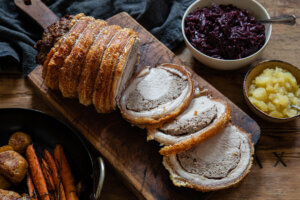
Here is a traditional, and not so traditional, approach to our pork middle. We send a lot of our pork middles out to chefs, ready for them to stuff and roast in their own way, using both the loin and the belly. You will see plenty of porchetta on the market that uses just the belly. This is different. Using both cuts gives balance, structure, and allows the flavour of the pork itself to shine.

For our website, we also offer a less traditional version, stuffed simply with our fennel sausage meat. That brings seasoning right through the joint, and a little extra fat to help keep everything moist during a long, slow roast.

It is a brilliant cut to have, either as a roast or the following day, sliced cold for sandwiches.
Winter and its cold hands have us fully in a tight embrace right now. And so we find ourselves cooking more often than not, to warm our souls. A ham at the weekend is one such thing that does the job. It can be used for all kinds of dishes and provide your weekdays with a plethora of fine sandwiches. But this fine cut also produces something else. An excellent, warming stock that should not be thrown away. In fact, it should be used to make something just as special. A deep, hearty split pea and ham soup. And here is @grylos showing you how to do it. Like most things, if you cook with time and consideration, the by-product is often just as good as the main event.
3 days ago
12316
View on Instagram |
1/8
Ask yourself this. When did you last have a really good pork chop?

This is why we keep coming back to it. Native, rare breed pork. Dry aged on the bone. Proper depth of flavour. Nothing like the pale, wet stuff you see elsewhere.

These are our Pork Chops with Rosemary and Anchovy Butter. Two thick, rindless chops. Two discs of handmade compound butter. Anchovy, rosemary, lemon zest, a little shallot. Old friends. It works.
Ask yourself this. When did you last have a really good pork chop?

This is why we keep coming back to it. Native, rare breed pork. Dry aged on the bone. Proper depth of flavour. Nothing like the pale, wet stuff you see elsewhere.

These are our Pork Chops with Rosemary and Anchovy Butter. Two thick, rindless chops. Two discs of handmade compound butter. Anchovy, rosemary, lemon zest, a little shallot. Old friends. It works.
Ask yourself this. When did you last have a really good pork chop? This is why we keep coming back to it. Native, rare breed pork. Dry aged on the bone. Proper depth of flavour. Nothing like the pale, wet stuff you see elsewhere. These are our Pork Chops with Rosemary and Anchovy Butter. Two thick, rindless chops. Two discs of handmade compound butter. Anchovy, rosemary, lemon zest, a little shallot. Old friends. It works.
1 week ago
462
View on Instagram |
2/8
Fancy a bit of a butcher’s tip? Or a hack, if you will. Well look no further. Here, @grylos, gets creative with a joint of boned and rolled beef rump, creating three, totally different meals, from the one piece of meat. A great example of some leftfield thinking and the perfect way to add a little variety into your weekly meal planning. Along the spectrum from raw to medium, your week could go a little something like this; tartare and toast lightly rubbed with garlic for lunch on Wednesday; steak night on Friday night, with chips, good red wine and a bowl of bearnaise; a roast dinner on Sunday. Bob’s your uncle, Fanny’s your aunt and a carnivorous and hugely satisfying week of eating is complete. All that from a single rolled rump of beef! A life hack if I ever saw one… Did you know that our rumps won 3 stars at the Great Taste Awards? 3-star rump, you can’t argue with that!
2 weeks ago
2505
View on Instagram |
3/8
Do you love bacon? Here’s our in house science and history teacher, @grylos, talking osmosis, salt, and the slow work of dry curing bacon.
2 weeks ago
3498
View on Instagram |
4/8
Burns Night, 25 January.

Two pastry wrapped tributes to Robert Burns.
Made with chef Josh Whitehead of @finer_pleasures.

A haggis sausage roll with coarse cut native breed pork.
A hot water crust pie of mutton and lamb haggis, oats, onions and spice.

Food for a cold night.
Burns Night, 25 January.

Two pastry wrapped tributes to Robert Burns.
Made with chef Josh Whitehead of @finer_pleasures.

A haggis sausage roll with coarse cut native breed pork.
A hot water crust pie of mutton and lamb haggis, oats, onions and spice.

Food for a cold night.
Burns Night, 25 January.

Two pastry wrapped tributes to Robert Burns.
Made with chef Josh Whitehead of @finer_pleasures.

A haggis sausage roll with coarse cut native breed pork.
A hot water crust pie of mutton and lamb haggis, oats, onions and spice.

Food for a cold night.
Burns Night, 25 January.

Two pastry wrapped tributes to Robert Burns.
Made with chef Josh Whitehead of @finer_pleasures.

A haggis sausage roll with coarse cut native breed pork.
A hot water crust pie of mutton and lamb haggis, oats, onions and spice.

Food for a cold night.
Burns Night, 25 January.

Two pastry wrapped tributes to Robert Burns.
Made with chef Josh Whitehead of @finer_pleasures.

A haggis sausage roll with coarse cut native breed pork.
A hot water crust pie of mutton and lamb haggis, oats, onions and spice.

Food for a cold night.
Burns Night, 25 January.

Two pastry wrapped tributes to Robert Burns.
Made with chef Josh Whitehead of @finer_pleasures.

A haggis sausage roll with coarse cut native breed pork.
A hot water crust pie of mutton and lamb haggis, oats, onions and spice.

Food for a cold night.
Burns Night, 25 January. Two pastry wrapped tributes to Robert Burns. Made with chef Josh Whitehead of @finer_pleasures. A haggis sausage roll with coarse cut native breed pork. A hot water crust pie of mutton and lamb haggis, oats, onions and spice. Food for a cold night.
3 weeks ago
1166
View on Instagram |
5/8
On many a recipe, the instruction ‘brown your mince’ is set out plainly enough. And yet, deep into January, when slow cooking is very much back on the table and recipes keep asking for the same thing, it feels worth saying that this is meant quite literally. Brown your mince. It does not say grey it. Browning is a process, not a gesture. It takes time, heat, and a little patience, and what you are doing is building flavour, not simply warming meat through. When mince is rushed, crowded into the pan, stirred too soon, it stews. It turns grey. The moisture stays put and the flavour never quite arrives. So here is @grylos , taking a moment to explain the difference, and to remind you that if you want the most from good produce, you have to let it work. Give it space. Leave it alone long enough to colour properly. Let it smell right before you move on. Because this is slow food month, after all. There is no need to hurry. Take your time, do it properly, and you will taste the difference in the finished dish.
4 weeks ago
2777
View on Instagram |
6/8
Winter. It felt strange being in Yorkshire, watching the news from the south where snow lay thick and sudden, while here January had arrived quietly, cold and wet, but not yet truly winter as we know it. Up here the season has always moved at a slower pace, and there is something steadying in remembering that. The idea that we should charge straight on after Christmas is a modern one, and it sits awkwardly with bodies and minds that are still tuned to pause, to take stock, to look back at the year just gone. 

Out on the farms, there is no rush but plenty to do. Some are already lambing, others preparing for it, working with the land rather than against it as the days begin, almost imperceptibly, to lengthen. The fields are still subdued, but there are signs, if you look closely, that life is beginning to stir again.

And so, it feels right, now and then, to slow everything down and simply notice Yorkshire in January, not as something to be endured, but as a quiet and beautiful part of the year in its own right.
Winter. It felt strange being in Yorkshire, watching the news from the south where snow lay thick and sudden, while here January had arrived quietly, cold and wet, but not yet truly winter as we know it. Up here the season has always moved at a slower pace, and there is something steadying in remembering that. The idea that we should charge straight on after Christmas is a modern one, and it sits awkwardly with bodies and minds that are still tuned to pause, to take stock, to look back at the year just gone. 

Out on the farms, there is no rush but plenty to do. Some are already lambing, others preparing for it, working with the land rather than against it as the days begin, almost imperceptibly, to lengthen. The fields are still subdued, but there are signs, if you look closely, that life is beginning to stir again.

And so, it feels right, now and then, to slow everything down and simply notice Yorkshire in January, not as something to be endured, but as a quiet and beautiful part of the year in its own right.
Winter. It felt strange being in Yorkshire, watching the news from the south where snow lay thick and sudden, while here January had arrived quietly, cold and wet, but not yet truly winter as we know it. Up here the season has always moved at a slower pace, and there is something steadying in remembering that. The idea that we should charge straight on after Christmas is a modern one, and it sits awkwardly with bodies and minds that are still tuned to pause, to take stock, to look back at the year just gone. 

Out on the farms, there is no rush but plenty to do. Some are already lambing, others preparing for it, working with the land rather than against it as the days begin, almost imperceptibly, to lengthen. The fields are still subdued, but there are signs, if you look closely, that life is beginning to stir again.

And so, it feels right, now and then, to slow everything down and simply notice Yorkshire in January, not as something to be endured, but as a quiet and beautiful part of the year in its own right.
Winter. It felt strange being in Yorkshire, watching the news from the south where snow lay thick and sudden, while here January had arrived quietly, cold and wet, but not yet truly winter as we know it. Up here the season has always moved at a slower pace, and there is something steadying in remembering that. The idea that we should charge straight on after Christmas is a modern one, and it sits awkwardly with bodies and minds that are still tuned to pause, to take stock, to look back at the year just gone. Out on the farms, there is no rush but plenty to do. Some are already lambing, others preparing for it, working with the land rather than against it as the days begin, almost imperceptibly, to lengthen. The fields are still subdued, but there are signs, if you look closely, that life is beginning to stir again. And so, it feels right, now and then, to slow everything down and simply notice Yorkshire in January, not as something to be endured, but as a quiet and beautiful part of the year in its own right.
4 weeks ago
712
View on Instagram |
7/8
Now the depths of winter descend. The excitement of Christmas has passed, but do not let that fool you. These months are still some of the best for eating roasted meats and leaning into deeper, newer flavour profiles. Here is a traditional, and not so traditional, approach to our pork middle. We send a lot of our pork middles out to chefs, ready for them to stuff and roast in their own way, using both the loin and the belly. You will see plenty of porchetta on the market that uses just the belly. This is different. Using both cuts gives balance, structure, and allows the flavour of the pork itself to shine. For our website, we also offer a less traditional version, stuffed simply with our fennel sausage meat. That brings seasoning right through the joint, and a little extra fat to help keep everything moist during a long, slow roast. It is a brilliant cut to have, either as a roast or the following day, sliced cold for sandwiches.
1 month ago
1401
View on Instagram |
8/8