Pork Recipes

George’s Traditional Pork Pie

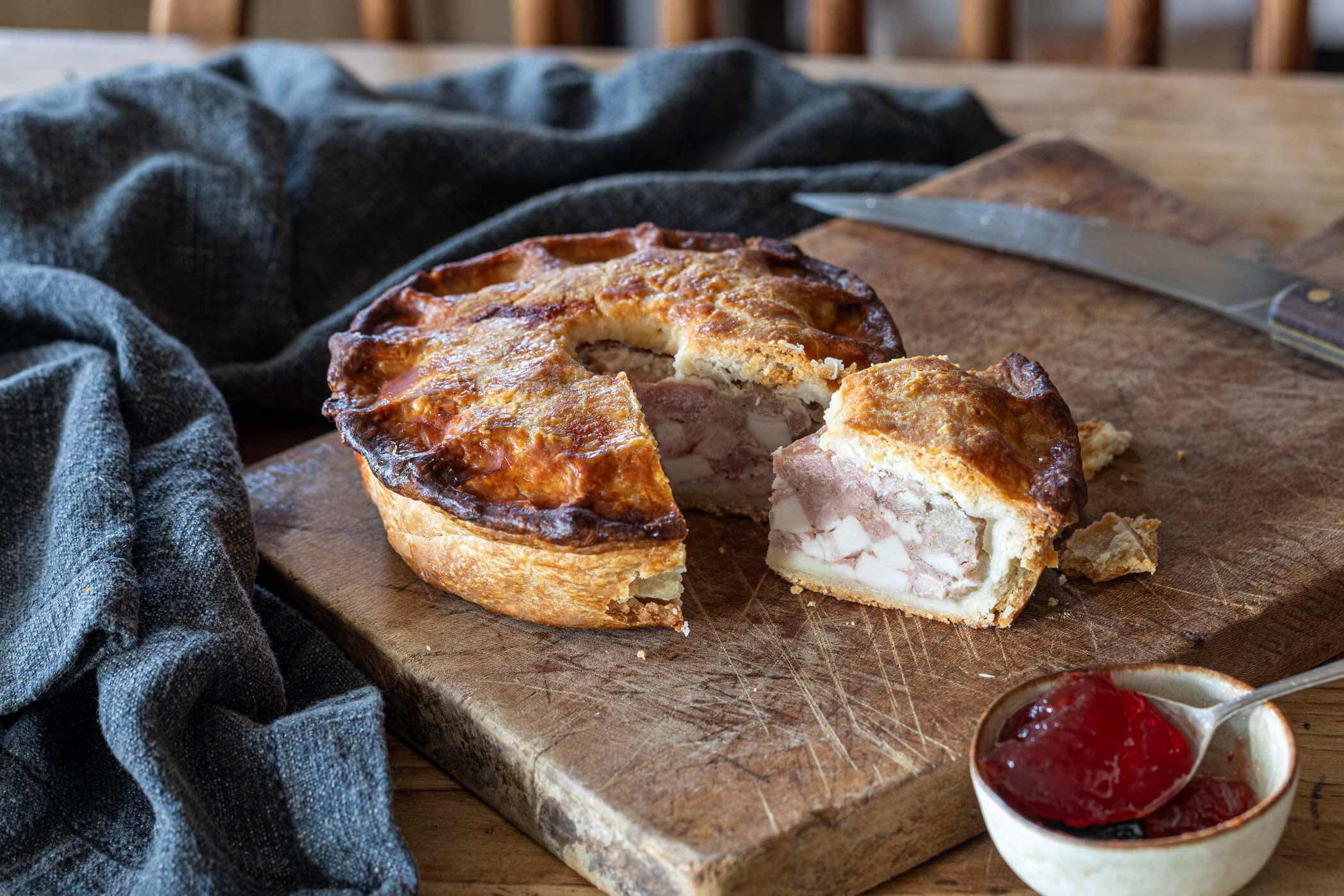
Join me on a journey – a journey towards the most perfect of centrepieces, fit to adorn any table. A pork pie recipe that is both rustic and ambitious, a nod to the days when a pie was a common sight in farmhouse kitchens and pantries across the country.

A pie in this form would traditionally have been a method of preserving – a kind of charcuterie in one of its crudest guises. Coarse meat wrapped in meat jelly and larded pastry, it provided a double layer of protection from the elements, preserving the meat for days before eventually feeding the family. Nowadays, we have fridges and supermarkets, online butchers, and artisan bakeries, so we don’t rely on pies in quite the same way. But that shouldn’t deter us from making one. All the time and effort that goes into this recipe is well worth it.

One thing you may notice about this recipe is that you’re going to have leftovers of both the rump ham and the pork belly. Fear not, this is a good thing. The ham can take care of itself – use Val’s Glazed Ham Recipe and feast on delicious ham sandwiches for the next week. With the belly, the possibilities are virtually endless – perhaps a crack at my Taiwanese Pork Belly Bao Buns with Pickled Vegetables?

So, put down Jamie’s 15-Minute Meals and indulge in some traditional, slow food cookery. By the end of this adventure, you’ll have something of unparalleled deliciousness.

Serves: 8-10

Prep time: 45 minutes

Cook time: 5 hours

Ingredients

Makes: 2 medium-sized pies, serving approximately 8–10 people.

For the Pastry:

For the Jelly:

Method

Preparing the Jelly

The jelly requires at least 4 hours to make, so it’s best to start this first—perhaps the day before you plan to use it:

  1. Simmer the Trotters: Place the pig’s trotters in a suitably sized pot and cover them with cold water. Bring the water to a boil, then reduce it to a gentle simmer.
  2. Skim and Add Ingredients: Skim off any scum that rises to the surface. Add the onion, carrot, celery, bay leaves, and peppercorns. Allow the mixture to cook at a gentle simmer for 4 hours. Partly cover the pot with a lid to minimise evaporation while still letting steam escape.
  3. Cool and Strain: After 4 hours, turn off the heat and let the liquid sit for 30 minutes.
  4. Chill the Jelly: Strain the liquid through a fine sieve, discarding the solids, and transfer it to the fridge to chill overnight.

This slow, deliberate process ensures a rich, flavourful jelly that’s perfect for your pork pie.

Making the Pastry and Shaping the Pie

  1. Melt the Lard: Place the lard and water into a saucepan and set it over medium heat. Cook until the lard has completely melted.
  2. Combine Ingredients: Tip the flour and 2 teaspoons of sea salt into a large mixing bowl. Carefully pour in the hot lard and water mixture.
  3. Form the Dough: Stir the mixture together with a wooden spoon (caution, the liquid will be hot!), then begin to knead gently with your hands until the dough comes together into a smooth ball.
  4. Rest the Dough: Cover the dough and set it aside to cool for around 30 minutes.
  5. Prepare the Mould: Find a suitably sized object to form the pies around. Traditionally, hand-raised pies use a pie “dolly”- a wooden cylinder for shaping. If you don’t have one, a round object like a small cake mould (about 10 cm in diameter) will work perfectly.
  6. Shape the Base: Divide the dough into three pieces. Take one piece and place it on the base of your chosen mould. Gently shape the dough around the mould with your hands, ensuring the pastry is evenly spread, about 7-8 cm deep and 3 mm thick. Repeat this process with the other two pieces of dough.
  7. Chill the Pastry Shells: Place the moulded pies in the fridge to chill until the pastry firms up. Once cooled, carefully remove the moulds, leaving the pastry shells intact.
  8. Prepare the Lids: Take the remaining dough, divide it in two, and roll each piece into discs about ½ cm thick. These will serve as the lids for your pies.

This method ensures a robust, beautifully shaped pastry ready to house the delicious pork filling.

Preparing the Filling

  1. Toast the Spices: Place the peppercorns, mace, fennel seeds, cloves, star anise, and juniper berries in a dry pan. Toast over medium heat until their aromas are released.
  2. Grind the Spices: Transfer the toasted spices to a pestle and mortar (or use a spice blender) and grind them into a fine powder.
  3. Mix the Filling: In a large mixing bowl, combine the pork mince, diced pork belly, and diced ham. Season with salt and add two teaspoons of the freshly ground spice blend. Mix thoroughly with your hands to ensure the seasoning is evenly distributed.
  4. Test for Seasoning: Heat a small frying pan and cook a little ball of the mixture. Taste and adjust the seasoning if necessary before proceeding.

This step ensures your filling is perfectly seasoned and packed with flavour, ready to fill your hand-raised pastry shells.

Assembling the Pies

  1. Fill the Pastry Shells: Spoon the pork mixture into the prepared pastry shells, filling them no more than three-quarters full. Press the mixture firmly into the corners to ensure there are no gaps.
  2. Prepare the Lids: Trim the pastry lids so they match the size of the pies. Place a lid on top of each filled pie and crimp the edges together, pinching firmly with your fingers to ensure a good seal between the lid and the base.
  3. Egg Wash and Vent: Brush the tops of the pies generously with beaten egg. Then, use a small knife to cut a hole in the centre of each lid. This vent will allow steam to escape during baking, helping to keep the crust crisp and golden.

Your pies are now ready for baking, with their rich filling securely encased in beautifully crimped pastry.

To Cook the Pies

  1. Preheat the Oven: Set your oven to 220°C.
  2. Bake the Pies: Place the pies on a baking tray lined with parchment paper and bake for 35 minutes.
  3. Lower the Heat: Reduce the oven temperature to 180°C and bake for an additional 20 minutes.
  4. Prepare the Jelly: While the pies are cooking, heat the jelly in a saucepan over medium heat. As it simmers, skim off any fat or scum that rises to the surface. For a clearer finish, you can clarify the jelly if desired. Season with salt and a splash of vinegar to taste.
  5. Cool Slightly and Fill with Jelly: Remove the pies from the oven and let them cool slightly for 10 minutes. Pour the hot jelly into the vent hole on top of each pie. Keep topping up every 5 minutes as the cooling meat shrinks, creating more space for the jelly. Continue until the pies are completely filled.
  6. Set and Chill: Allow the pies to cool at room temperature for several hours to let the jelly fully set.
  7. Storage: The pies will keep well in the fridge for at least 5 days, making them perfect for planning ahead or enjoying leftovers.

These steps ensure a beautifully set jelly and perfectly cooked pies, ready to impress!

Order meat online

Instagram

  • There might not be a food that is more of this generation than fried chicken. It’s eminently Instagram-able (or TikTok-able depending on your age), malleable to various cuisines and extremely delicious. Plus, it has just the right amount of technique, if you know what I mean. The sort of thing that, if you’re not giving it the requisite thought and attention, can be a bit ropey. No danger of that here though…

@Grylos has given it the Swaledale treatment, i.e. keeping it simple, making it delicious and showing off our incredible meat. So, with no more than a saffron aioli, some shredded iceberg and a few sliced pickles, this is the fried chicken burger of dreams! Oh, sorry, nearly forgot the crispy chicken skin – told you there was just the right amount of technique. 

There are few things that we would want to munch down for lunch more than one of these bad boys. Give ‘em a whirl!
  • Always good to welcome chefs to the butchery. Earlier this week the teams from @llewelynslondon came up to see us. We showed them around the cutting room, talked through how we work, then headed up the hill for a bit of cooking and conversation.

For many chefs it is the first chance to see the whole journey. From the farms and fields where the animals are raised, through our ageing rooms, and finally into the kitchens that cook it.

If you are a chef and fancy a visit this year, you would be very welcome. Send us a message and we will put the kettle on.
  • March sits between seasons. Winter has not quite loosened its grip, and there is still time, and need, for fortifying pleasures. A bowl of chicken broth is one of them.

It begins with a proper chicken stock. Just bones and time in the pot, slowly giving up their flavour until the liquid runs clear and deeply savoury. If you watched our earlier film on how to break down a whole chicken, this is where the rest of it finds its purpose.

From there the broth is built. Pearl barley for substance. Cavolo nero and turnips for the season. Simple things, allowed to do their work in good stock.

Just before serving, a small splash of oloroso lifts the whole bowl.
  • British Pie Week, apparently.

We do not usually pay much attention to themed food weeks. We prefer to make and sell things when they feel right.

This year is different, thanks to our growing friendship with Yorkshire chef and pie obsessive Josh Whitehead, and his excellent pie project, Finer Pleasures.

Josh started @finer_pleasures in 2023 to make pies the way they should be made. Proper fillings, local meat and traditional methods.

So we thought we would join in.

The pie is a classic. Chicken, ham, leek and mushroom.

Brined chicken, smoked ham hock and a rich velouté finished with herbs, mustard and chestnut mushrooms or leeks.

A proper pie.

Available this week while they last.
  • It’s easy to become disconnected with the restaurants and kitchens where our meat ends up being prepped, cooked and served. Whilst Instagram can give us a certain understanding of how the food looks; we all know that there is no substitute for experiencing it first-hand. And that is what we had the pleasure of doing this week at the Canton Arms. One of London’s great pubs and one of our oldest, most significant customers. We have been suppling them with exceptional meat since nearly the very beginning of the Swaledale journey. 

Last night was a moment to celebrate that relationship in all its glory; our meat and their cooking and outstanding hospitality coming together for what was a grand evening. We ate, we drank, we chatted in a room that was alive. Long may dining rooms like this thrive and continue to provide people with a space to consume food, booze and hospitality in such a joyous way. 

It was a special night for us, and we hope for everyone who was there. 

Thanks to @chargieb , @cantontrish, @petea25 and the @cantonarms team for being total legends xx

Ps sorry for not getting any decent pics of the food! Was having too much fun.
  • We have all seen the videos. A chicken arrives. Five neat strokes of a knife. It falls apart as if by magic. That comes from thirty years at the block. Most of us do not have that.

So here is a slightly more Radio 4 approach.

A calm, sensible way to take a good chicken and break it down at home. Nothing flashy. Just understanding the joints, working with the bone, and giving each part the respect it deserves. When you do that, you open up a week (almost) of meals. Breasts cooked one way. Legs another. A carcass that becomes stock rather than waste. More on that to follow.

The only things you truly need are a great chicken and a proper knife. Ours is a beautiful honsuki knife kindly supplied by @kitchenprovisions and it does the job expertly. Sharp. Balanced. Delightful.

Watch along as @grylos talks it through.
  • Mutton has earned itself an unfair reputation. For centuries it was simply the meat we ate. Lamb is, in many ways, the modern preference, made possible by refrigeration and global trade. Before that shift, it would have made little sense to slaughter an animal before it had lived fully and bred. Sheep were kept for wool and continuity, and when their working life was complete, they became mutton.

It was part of a cycle. Practical and sustaining. What changed was not the meat, but our habits.

Yet not all mutton is equal. Age alone does not create depth. Mutton reflects the life it has lived. When sheep are kept longer and allowed to graze widely on varied forage, moorland grasses and herbal leys, time and terrain build complexity into the muscle and fat.

That is the mutton we favour and source. Darker, firmer and deeper in flavour, shaped by prolonged grazing on moorland such as this, just outside Skipton.

There was once a rhythm between wool on our backs and mutton on our tables. Perhaps that rhythm still makes sense.
  • Kindred spirits. Hot pans. Spiced mutton.
Swaledale x Canton Arms supper.
Wednesday 25 February.
To book email Thecantonarms@gmail.com

@cantonarms
There might not be a food that is more of this generation than fried chicken. It’s eminently Instagram-able (or TikTok-able depending on your age), malleable to various cuisines and extremely delicious. Plus, it has just the right amount of technique, if you know what I mean. The sort of thing that, if you’re not giving it the requisite thought and attention, can be a bit ropey. No danger of that here though… @Grylos has given it the Swaledale treatment, i.e. keeping it simple, making it delicious and showing off our incredible meat. So, with no more than a saffron aioli, some shredded iceberg and a few sliced pickles, this is the fried chicken burger of dreams! Oh, sorry, nearly forgot the crispy chicken skin – told you there was just the right amount of technique. There are few things that we would want to munch down for lunch more than one of these bad boys. Give ‘em a whirl!
15 hours ago
303
View on Instagram |
1/8
Always good to welcome chefs to the butchery. Earlier this week the teams from @llewelynslondon came up to see us. We showed them around the cutting room, talked through how we work, then headed up the hill for a bit of cooking and conversation.

For many chefs it is the first chance to see the whole journey. From the farms and fields where the animals are raised, through our ageing rooms, and finally into the kitchens that cook it.

If you are a chef and fancy a visit this year, you would be very welcome. Send us a message and we will put the kettle on.
Always good to welcome chefs to the butchery. Earlier this week the teams from @llewelynslondon came up to see us. We showed them around the cutting room, talked through how we work, then headed up the hill for a bit of cooking and conversation.

For many chefs it is the first chance to see the whole journey. From the farms and fields where the animals are raised, through our ageing rooms, and finally into the kitchens that cook it.

If you are a chef and fancy a visit this year, you would be very welcome. Send us a message and we will put the kettle on.
Always good to welcome chefs to the butchery. Earlier this week the teams from @llewelynslondon came up to see us. We showed them around the cutting room, talked through how we work, then headed up the hill for a bit of cooking and conversation.

For many chefs it is the first chance to see the whole journey. From the farms and fields where the animals are raised, through our ageing rooms, and finally into the kitchens that cook it.

If you are a chef and fancy a visit this year, you would be very welcome. Send us a message and we will put the kettle on.
Always good to welcome chefs to the butchery. Earlier this week the teams from @llewelynslondon came up to see us. We showed them around the cutting room, talked through how we work, then headed up the hill for a bit of cooking and conversation. For many chefs it is the first chance to see the whole journey. From the farms and fields where the animals are raised, through our ageing rooms, and finally into the kitchens that cook it. If you are a chef and fancy a visit this year, you would be very welcome. Send us a message and we will put the kettle on.
1 week ago
49
View on Instagram |
2/8
March sits between seasons. Winter has not quite loosened its grip, and there is still time, and need, for fortifying pleasures. A bowl of chicken broth is one of them. It begins with a proper chicken stock. Just bones and time in the pot, slowly giving up their flavour until the liquid runs clear and deeply savoury. If you watched our earlier film on how to break down a whole chicken, this is where the rest of it finds its purpose. From there the broth is built. Pearl barley for substance. Cavolo nero and turnips for the season. Simple things, allowed to do their work in good stock. Just before serving, a small splash of oloroso lifts the whole bowl.
1 week ago
932
View on Instagram |
3/8
British Pie Week, apparently.

We do not usually pay much attention to themed food weeks. We prefer to make and sell things when they feel right.

This year is different, thanks to our growing friendship with Yorkshire chef and pie obsessive Josh Whitehead, and his excellent pie project, Finer Pleasures.

Josh started @finer_pleasures in 2023 to make pies the way they should be made. Proper fillings, local meat and traditional methods.

So we thought we would join in.

The pie is a classic. Chicken, ham, leek and mushroom.

Brined chicken, smoked ham hock and a rich velouté finished with herbs, mustard and chestnut mushrooms or leeks.

A proper pie.

Available this week while they last.
British Pie Week, apparently.

We do not usually pay much attention to themed food weeks. We prefer to make and sell things when they feel right.

This year is different, thanks to our growing friendship with Yorkshire chef and pie obsessive Josh Whitehead, and his excellent pie project, Finer Pleasures.

Josh started @finer_pleasures in 2023 to make pies the way they should be made. Proper fillings, local meat and traditional methods.

So we thought we would join in.

The pie is a classic. Chicken, ham, leek and mushroom.

Brined chicken, smoked ham hock and a rich velouté finished with herbs, mustard and chestnut mushrooms or leeks.

A proper pie.

Available this week while they last.
British Pie Week, apparently.

We do not usually pay much attention to themed food weeks. We prefer to make and sell things when they feel right.

This year is different, thanks to our growing friendship with Yorkshire chef and pie obsessive Josh Whitehead, and his excellent pie project, Finer Pleasures.

Josh started @finer_pleasures in 2023 to make pies the way they should be made. Proper fillings, local meat and traditional methods.

So we thought we would join in.

The pie is a classic. Chicken, ham, leek and mushroom.

Brined chicken, smoked ham hock and a rich velouté finished with herbs, mustard and chestnut mushrooms or leeks.

A proper pie.

Available this week while they last.
British Pie Week, apparently. We do not usually pay much attention to themed food weeks. We prefer to make and sell things when they feel right. This year is different, thanks to our growing friendship with Yorkshire chef and pie obsessive Josh Whitehead, and his excellent pie project, Finer Pleasures. Josh started @finer_pleasures in 2023 to make pies the way they should be made. Proper fillings, local meat and traditional methods. So we thought we would join in. The pie is a classic. Chicken, ham, leek and mushroom. Brined chicken, smoked ham hock and a rich velouté finished with herbs, mustard and chestnut mushrooms or leeks. A proper pie. Available this week while they last.
2 weeks ago
591
View on Instagram |
4/8
It’s easy to become disconnected with the restaurants and kitchens where our meat ends up being prepped, cooked and served. Whilst Instagram can give us a certain understanding of how the food looks; we all know that there is no substitute for experiencing it first-hand. And that is what we had the pleasure of doing this week at the Canton Arms. One of London’s great pubs and one of our oldest, most significant customers. We have been suppling them with exceptional meat since nearly the very beginning of the Swaledale journey. 

Last night was a moment to celebrate that relationship in all its glory; our meat and their cooking and outstanding hospitality coming together for what was a grand evening. We ate, we drank, we chatted in a room that was alive. Long may dining rooms like this thrive and continue to provide people with a space to consume food, booze and hospitality in such a joyous way. 

It was a special night for us, and we hope for everyone who was there. 

Thanks to @chargieb , @cantontrish, @petea25 and the @cantonarms team for being total legends xx

Ps sorry for not getting any decent pics of the food! Was having too much fun.
It’s easy to become disconnected with the restaurants and kitchens where our meat ends up being prepped, cooked and served. Whilst Instagram can give us a certain understanding of how the food looks; we all know that there is no substitute for experiencing it first-hand. And that is what we had the pleasure of doing this week at the Canton Arms. One of London’s great pubs and one of our oldest, most significant customers. We have been suppling them with exceptional meat since nearly the very beginning of the Swaledale journey. Last night was a moment to celebrate that relationship in all its glory; our meat and their cooking and outstanding hospitality coming together for what was a grand evening. We ate, we drank, we chatted in a room that was alive. Long may dining rooms like this thrive and continue to provide people with a space to consume food, booze and hospitality in such a joyous way. It was a special night for us, and we hope for everyone who was there. Thanks to @chargieb , @cantontrish, @petea25 and the @cantonarms team for being total legends xx Ps sorry for not getting any decent pics of the food! Was having too much fun.
3 weeks ago
1514
View on Instagram |
5/8
We have all seen the videos. A chicken arrives. Five neat strokes of a knife. It falls apart as if by magic. That comes from thirty years at the block. Most of us do not have that. So here is a slightly more Radio 4 approach. A calm, sensible way to take a good chicken and break it down at home. Nothing flashy. Just understanding the joints, working with the bone, and giving each part the respect it deserves. When you do that, you open up a week (almost) of meals. Breasts cooked one way. Legs another. A carcass that becomes stock rather than waste. More on that to follow. The only things you truly need are a great chicken and a proper knife. Ours is a beautiful honsuki knife kindly supplied by @kitchenprovisions and it does the job expertly. Sharp. Balanced. Delightful. Watch along as @grylos talks it through.
4 weeks ago
652
View on Instagram |
6/8
Mutton has earned itself an unfair reputation. For centuries it was simply the meat we ate. Lamb is, in many ways, the modern preference, made possible by refrigeration and global trade. Before that shift, it would have made little sense to slaughter an animal before it had lived fully and bred. Sheep were kept for wool and continuity, and when their working life was complete, they became mutton.

It was part of a cycle. Practical and sustaining. What changed was not the meat, but our habits.

Yet not all mutton is equal. Age alone does not create depth. Mutton reflects the life it has lived. When sheep are kept longer and allowed to graze widely on varied forage, moorland grasses and herbal leys, time and terrain build complexity into the muscle and fat.

That is the mutton we favour and source. Darker, firmer and deeper in flavour, shaped by prolonged grazing on moorland such as this, just outside Skipton.

There was once a rhythm between wool on our backs and mutton on our tables. Perhaps that rhythm still makes sense.
Mutton has earned itself an unfair reputation. For centuries it was simply the meat we ate. Lamb is, in many ways, the modern preference, made possible by refrigeration and global trade. Before that shift, it would have made little sense to slaughter an animal before it had lived fully and bred. Sheep were kept for wool and continuity, and when their working life was complete, they became mutton.

It was part of a cycle. Practical and sustaining. What changed was not the meat, but our habits.

Yet not all mutton is equal. Age alone does not create depth. Mutton reflects the life it has lived. When sheep are kept longer and allowed to graze widely on varied forage, moorland grasses and herbal leys, time and terrain build complexity into the muscle and fat.

That is the mutton we favour and source. Darker, firmer and deeper in flavour, shaped by prolonged grazing on moorland such as this, just outside Skipton.

There was once a rhythm between wool on our backs and mutton on our tables. Perhaps that rhythm still makes sense.
Mutton has earned itself an unfair reputation. For centuries it was simply the meat we ate. Lamb is, in many ways, the modern preference, made possible by refrigeration and global trade. Before that shift, it would have made little sense to slaughter an animal before it had lived fully and bred. Sheep were kept for wool and continuity, and when their working life was complete, they became mutton.

It was part of a cycle. Practical and sustaining. What changed was not the meat, but our habits.

Yet not all mutton is equal. Age alone does not create depth. Mutton reflects the life it has lived. When sheep are kept longer and allowed to graze widely on varied forage, moorland grasses and herbal leys, time and terrain build complexity into the muscle and fat.

That is the mutton we favour and source. Darker, firmer and deeper in flavour, shaped by prolonged grazing on moorland such as this, just outside Skipton.

There was once a rhythm between wool on our backs and mutton on our tables. Perhaps that rhythm still makes sense.
Mutton has earned itself an unfair reputation. For centuries it was simply the meat we ate. Lamb is, in many ways, the modern preference, made possible by refrigeration and global trade. Before that shift, it would have made little sense to slaughter an animal before it had lived fully and bred. Sheep were kept for wool and continuity, and when their working life was complete, they became mutton.

It was part of a cycle. Practical and sustaining. What changed was not the meat, but our habits.

Yet not all mutton is equal. Age alone does not create depth. Mutton reflects the life it has lived. When sheep are kept longer and allowed to graze widely on varied forage, moorland grasses and herbal leys, time and terrain build complexity into the muscle and fat.

That is the mutton we favour and source. Darker, firmer and deeper in flavour, shaped by prolonged grazing on moorland such as this, just outside Skipton.

There was once a rhythm between wool on our backs and mutton on our tables. Perhaps that rhythm still makes sense.
Mutton has earned itself an unfair reputation. For centuries it was simply the meat we ate. Lamb is, in many ways, the modern preference, made possible by refrigeration and global trade. Before that shift, it would have made little sense to slaughter an animal before it had lived fully and bred. Sheep were kept for wool and continuity, and when their working life was complete, they became mutton. It was part of a cycle. Practical and sustaining. What changed was not the meat, but our habits. Yet not all mutton is equal. Age alone does not create depth. Mutton reflects the life it has lived. When sheep are kept longer and allowed to graze widely on varied forage, moorland grasses and herbal leys, time and terrain build complexity into the muscle and fat. That is the mutton we favour and source. Darker, firmer and deeper in flavour, shaped by prolonged grazing on moorland such as this, just outside Skipton. There was once a rhythm between wool on our backs and mutton on our tables. Perhaps that rhythm still makes sense.
1 month ago
511
View on Instagram |
7/8
Kindred spirits. Hot pans. Spiced mutton. Swaledale x Canton Arms supper. Wednesday 25 February. To book email Thecantonarms@gmail.com @cantonarms
1 month ago
1546
View on Instagram |
8/8