Uncategorised

Potato Scones with Ham Hock & Poached Eggs

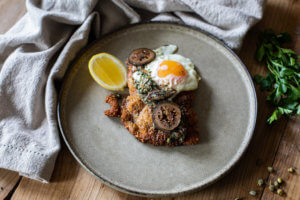
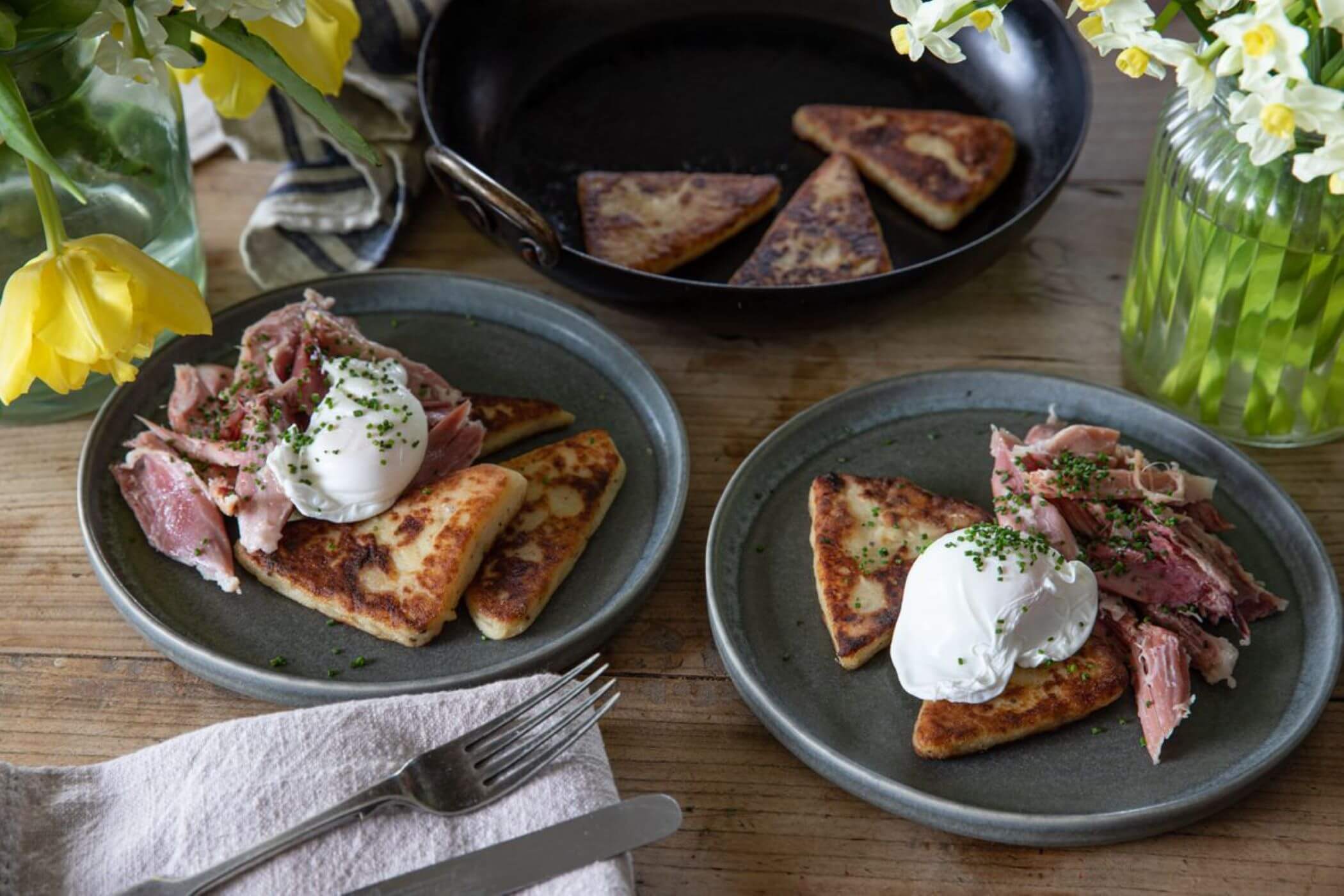
Two plates of potato scones topped with flaked ham hock and a poached egg.

For those with a soft spot for brunch, here is a perfect little number for a slow Sunday morning. These potato scones are a curious little thing. Mashed potatoes, bound with flour and seasoned with black pepper and a touch of grated nutmeg, take on a transformation when they are gently fried in a little clarified butter. Crisp and brown, with a soft, warm centre, it’s a lovely thing to factor into your brunch. Here they are served with flaked ham hock and a runny poached egg. And lots of chopped chives – because where there is brunch and eggs, there are chives. It’s a rule.

Serves: 4

Cook time: 3 hours 30 minutes

Ingredients

For the potato scones

Method

To cook the ham hock:

  1. Place the hock in a large pot and cover with cold water. Place over a high heat and bring to a boil, then reduce the heat to maintain a gentle simmer.
  2. After 10 minutes, use a ladle to skim off any foam or scum that rises to the surface of the pot, then add the bay leaves, carrots, peppercorns, and fennel seeds. Cook with a loose-fitting lid at a gentle simmer for around 2 ½ hours.
  3. Check if the hock is cooked — if the bone releases easily from the flesh, then it is cooked. If cooked, then remove from the heat and leave to cool slightly in the liquid. If not, then continue cooking for the necessary time.
  4. Once the hock has sufficiently cooled, remove it from the liquid and begin to pick the meat. Discard the bones and then separate the flesh from the skin. I like to incorporate a little of the skin and plenty of the fat. How much of that you want is a matter of personal taste.
  5. Keep the cooking liquid from the hock — it will serve as a wonderful stock for something else.

For the scones:

  1. Preheat your oven to 180°C.
  2. Use a small knife to pierce the skin of the potatoes in various places. Season with salt and then place on an oven tray and then into the oven for about an hour.
  3. Remove from the oven and leave to cool slightly. Then cut in half and scoop out the flesh into a potato ricer or mouli legumes.
    Once all the potato is mashed, lay it on a clean work surface and add 3 tablespoons of the melted butter, several grinds of black pepper, and a grating of nutmeg. Then sprinkle evenly over the flour — it should resemble a light dusting of snow on the hilltops.
  4. Season the whole lot with fine sea salt, and then, using your hands or a dough scraper, begin to bring it together by gently kneading until everything is combined. Adding a dusting more flour to the work surface if needed. Be careful not to overwork the dough as this can leave it with a rather ‘gluey’ feel.
  5. Dust the work surface with flour, then roll the mixture out to about 1 ½ – 2cm thickness. Dust the top with a little flour, and then cut out the scones into triangles. Lay them on a piece of parchment paper, ready to fry.
  6. Set a frying pan over a low-medium heat and then add 2 tablespoons of the melted butter, taking only the clear liquid from the top, leaving the milk solids at the bottom. In batches, being careful not to overfill the pan, fry off the potato scones. Keep the heat low and take your time, about 2 minutes on each side, or until a lovely brown crust has formed. Repeat this process until all the scones are cooked.

To poach the eggs:

  1. Fill a tall pan with water and set over a high heat. Bring to the boil and then turn down to a very gentle simmer.
  2. Add 3 tablespoons of white wine vinegar to the water. Then break in 4 of the eggs and cook for 2-2 ½ minutes. Then remove from the water with a slotted spoon and drain on a tea towel. Season with salt and a little black pepper. Repeat until all the eggs are poached.

    To serve: Scones, poached eggs, and a pile of ham hock on the plate with chopped chives over the top.


Order meat online

Instagram

  • The fallacy of Spring lamb!

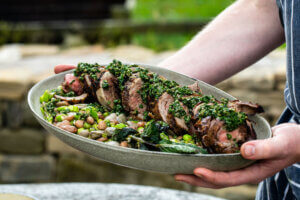
When we eat lamb in early April, we aren’t eating the lovely little fluffy things people see hopping about in the fields. In fact, you’re actually eating – or at least you are if you are buying from us – old season lamb. The animals that were born the previous springtime. They are age wise, on the verge of morphing into hogget and, in our opinion, it is lamb at its very best. More flavourful as the meat has developed with age, but still with the tenderness one expects with lamb. 
One thing that is not in doubt is that it pairs perfectly with a lot of the seasonal ingredients of this time of year, the peas, broad beans and courgettes from the continent, plus Jersey royals, asparagus and wild garlic from these shores. 
We have plenty of these wonderful carcasses ageing in our fridges, so embrace the idea of eating last years spring lamb!
  • A classic of French cooking, built on combinations that have stood their ground for good reason, and long may they do so.

Chicken breast roasted in brown butter, creamy mash worked with plenty of butter and dairy, and a mustard sauce brought together with cream. It reads rich, but it eats with balance. The Dijon and tarragon cut through, lifting the dish and keeping it in check.
  • A classic of French cooking, built on combinations that have stood their ground for good reason, and long may they do so.

Chicken breast roasted in brown butter, creamy mash worked with plenty of butter and dairy, and a mustard sauce brought together with cream. It reads rich, but it eats with balance. The Dijon and tarragon cut through, lifting the dish and keeping it in check.

This is food that does not chase anything. It knows exactly what it is.
  • Filmed on a blustery day at the Harewood House estate, Ellen talks us through the Highland cattle and the wider farming approach shaping the land here.

These short films look at how the estate is guiding the land back towards what it once was, using the right livestock for the right terrain and allowing systems to work with the landscape rather than against it. Hardy cattle, able to outwinter on pasture alone, reduce the need for inputs and bring a different kind of balance to the farm.

For chefs, this is where the story begins. The flavour comes later, but it is built here, in the fields, through decisions made over time rather than in a single season.

It is a strong example of thoughtful farming, where lower inputs and careful management can support both the land and a sustainable margin, all driven by a clear intention to make the estate work for nature as much as it does for people.
  • We love it when a plan comes together! And this little project with @llewelynslondon provides a great example. 

It all started with a trip up to Swaledale HQ, to see the butchery and meet the team; bacon, black pudding and egg baps were laid on fo breakfast. Then it was off to see one of our network of farmers; Jim Mallender, over in Thornton in craven. Jim and his family showed us round and held a sort of farming Q&A. Then we cooked some cuts on a bbq and sampled the llewelyns take on a hotpot. Truly bringing farmers and chef together and a wonderful day for all involved. 

Off the back of the visit a special dinner an d a three course menu of dreams. It celebrates not just our produce and their cooking but also the 6 beautiful years that head chef michael (@skinnylittlefatman) has spent at the helm of this charming restaurant. 

We are extremely excited to eat and drink tonight to celebrate all those things.
  • There might not be a food that is more of this generation than fried chicken. It’s eminently Instagram-able (or TikTok-able depending on your age), malleable to various cuisines and extremely delicious. Plus, it has just the right amount of technique, if you know what I mean. The sort of thing that, if you’re not giving it the requisite thought and attention, can be a bit ropey. No danger of that here though…

@Grylos has given it the Swaledale treatment, i.e. keeping it simple, making it delicious and showing off our incredible meat. So, with no more than a saffron aioli, some shredded iceberg and a few sliced pickles, this is the fried chicken burger of dreams! Oh, sorry, nearly forgot the crispy chicken skin – told you there was just the right amount of technique. 

There are few things that we would want to munch down for lunch more than one of these bad boys. Give ‘em a whirl!
  • Always good to welcome chefs to the butchery. Earlier this week the teams from @llewelynslondon came up to see us. We showed them around the cutting room, talked through how we work, then headed up the hill for a bit of cooking and conversation.

For many chefs it is the first chance to see the whole journey. From the farms and fields where the animals are raised, through our ageing rooms, and finally into the kitchens that cook it.

If you are a chef and fancy a visit this year, you would be very welcome. Send us a message and we will put the kettle on.
  • March sits between seasons. Winter has not quite loosened its grip, and there is still time, and need, for fortifying pleasures. A bowl of chicken broth is one of them.

It begins with a proper chicken stock. Just bones and time in the pot, slowly giving up their flavour until the liquid runs clear and deeply savoury. If you watched our earlier film on how to break down a whole chicken, this is where the rest of it finds its purpose.

From there the broth is built. Pearl barley for substance. Cavolo nero and turnips for the season. Simple things, allowed to do their work in good stock.

Just before serving, a small splash of oloroso lifts the whole bowl.
The fallacy of Spring lamb! When we eat lamb in early April, we aren’t eating the lovely little fluffy things people see hopping about in the fields. In fact, you’re actually eating – or at least you are if you are buying from us – old season lamb. The animals that were born the previous springtime. They are age wise, on the verge of morphing into hogget and, in our opinion, it is lamb at its very best. More flavourful as the meat has developed with age, but still with the tenderness one expects with lamb. One thing that is not in doubt is that it pairs perfectly with a lot of the seasonal ingredients of this time of year, the peas, broad beans and courgettes from the continent, plus Jersey royals, asparagus and wild garlic from these shores. We have plenty of these wonderful carcasses ageing in our fridges, so embrace the idea of eating last years spring lamb!
1 week ago
602
View on Instagram |
1/8
A classic of French cooking, built on combinations that have stood their ground for good reason, and long may they do so. Chicken breast roasted in brown butter, creamy mash worked with plenty of butter and dairy, and a mustard sauce brought together with cream. It reads rich, but it eats with balance. The Dijon and tarragon cut through, lifting the dish and keeping it in check.
3 weeks ago
7
View on Instagram |
2/8
A classic of French cooking, built on combinations that have stood their ground for good reason, and long may they do so. Chicken breast roasted in brown butter, creamy mash worked with plenty of butter and dairy, and a mustard sauce brought together with cream. It reads rich, but it eats with balance. The Dijon and tarragon cut through, lifting the dish and keeping it in check. This is food that does not chase anything. It knows exactly what it is.
3 weeks ago
535
View on Instagram |
3/8
Filmed on a blustery day at the Harewood House estate, Ellen talks us through the Highland cattle and the wider farming approach shaping the land here. These short films look at how the estate is guiding the land back towards what it once was, using the right livestock for the right terrain and allowing systems to work with the landscape rather than against it. Hardy cattle, able to outwinter on pasture alone, reduce the need for inputs and bring a different kind of balance to the farm. For chefs, this is where the story begins. The flavour comes later, but it is built here, in the fields, through decisions made over time rather than in a single season. It is a strong example of thoughtful farming, where lower inputs and careful management can support both the land and a sustainable margin, all driven by a clear intention to make the estate work for nature as much as it does for people.
4 weeks ago
64
View on Instagram |
4/8
We love it when a plan comes together! And this little project with @llewelynslondon provides a great example. It all started with a trip up to Swaledale HQ, to see the butchery and meet the team; bacon, black pudding and egg baps were laid on fo breakfast. Then it was off to see one of our network of farmers; Jim Mallender, over in Thornton in craven. Jim and his family showed us round and held a sort of farming Q&A. Then we cooked some cuts on a bbq and sampled the llewelyns take on a hotpot. Truly bringing farmers and chef together and a wonderful day for all involved. Off the back of the visit a special dinner an d a three course menu of dreams. It celebrates not just our produce and their cooking but also the 6 beautiful years that head chef michael (@skinnylittlefatman) has spent at the helm of this charming restaurant. We are extremely excited to eat and drink tonight to celebrate all those things.
4 weeks ago
58
View on Instagram |
5/8
There might not be a food that is more of this generation than fried chicken. It’s eminently Instagram-able (or TikTok-able depending on your age), malleable to various cuisines and extremely delicious. Plus, it has just the right amount of technique, if you know what I mean. The sort of thing that, if you’re not giving it the requisite thought and attention, can be a bit ropey. No danger of that here though… @Grylos has given it the Swaledale treatment, i.e. keeping it simple, making it delicious and showing off our incredible meat. So, with no more than a saffron aioli, some shredded iceberg and a few sliced pickles, this is the fried chicken burger of dreams! Oh, sorry, nearly forgot the crispy chicken skin – told you there was just the right amount of technique. There are few things that we would want to munch down for lunch more than one of these bad boys. Give ‘em a whirl!
1 month ago
665
View on Instagram |
6/8
Always good to welcome chefs to the butchery. Earlier this week the teams from @llewelynslondon came up to see us. We showed them around the cutting room, talked through how we work, then headed up the hill for a bit of cooking and conversation.

For many chefs it is the first chance to see the whole journey. From the farms and fields where the animals are raised, through our ageing rooms, and finally into the kitchens that cook it.

If you are a chef and fancy a visit this year, you would be very welcome. Send us a message and we will put the kettle on.
Always good to welcome chefs to the butchery. Earlier this week the teams from @llewelynslondon came up to see us. We showed them around the cutting room, talked through how we work, then headed up the hill for a bit of cooking and conversation.

For many chefs it is the first chance to see the whole journey. From the farms and fields where the animals are raised, through our ageing rooms, and finally into the kitchens that cook it.

If you are a chef and fancy a visit this year, you would be very welcome. Send us a message and we will put the kettle on.
Always good to welcome chefs to the butchery. Earlier this week the teams from @llewelynslondon came up to see us. We showed them around the cutting room, talked through how we work, then headed up the hill for a bit of cooking and conversation.

For many chefs it is the first chance to see the whole journey. From the farms and fields where the animals are raised, through our ageing rooms, and finally into the kitchens that cook it.

If you are a chef and fancy a visit this year, you would be very welcome. Send us a message and we will put the kettle on.
Always good to welcome chefs to the butchery. Earlier this week the teams from @llewelynslondon came up to see us. We showed them around the cutting room, talked through how we work, then headed up the hill for a bit of cooking and conversation. For many chefs it is the first chance to see the whole journey. From the farms and fields where the animals are raised, through our ageing rooms, and finally into the kitchens that cook it. If you are a chef and fancy a visit this year, you would be very welcome. Send us a message and we will put the kettle on.
1 month ago
52
View on Instagram |
7/8
March sits between seasons. Winter has not quite loosened its grip, and there is still time, and need, for fortifying pleasures. A bowl of chicken broth is one of them. It begins with a proper chicken stock. Just bones and time in the pot, slowly giving up their flavour until the liquid runs clear and deeply savoury. If you watched our earlier film on how to break down a whole chicken, this is where the rest of it finds its purpose. From there the broth is built. Pearl barley for substance. Cavolo nero and turnips for the season. Simple things, allowed to do their work in good stock. Just before serving, a small splash of oloroso lifts the whole bowl.
1 month ago
962
View on Instagram |
8/8