How-To Guides

How to Cook Wild Mushrooms: A Seasonal Guide to Preparation & Inspiration

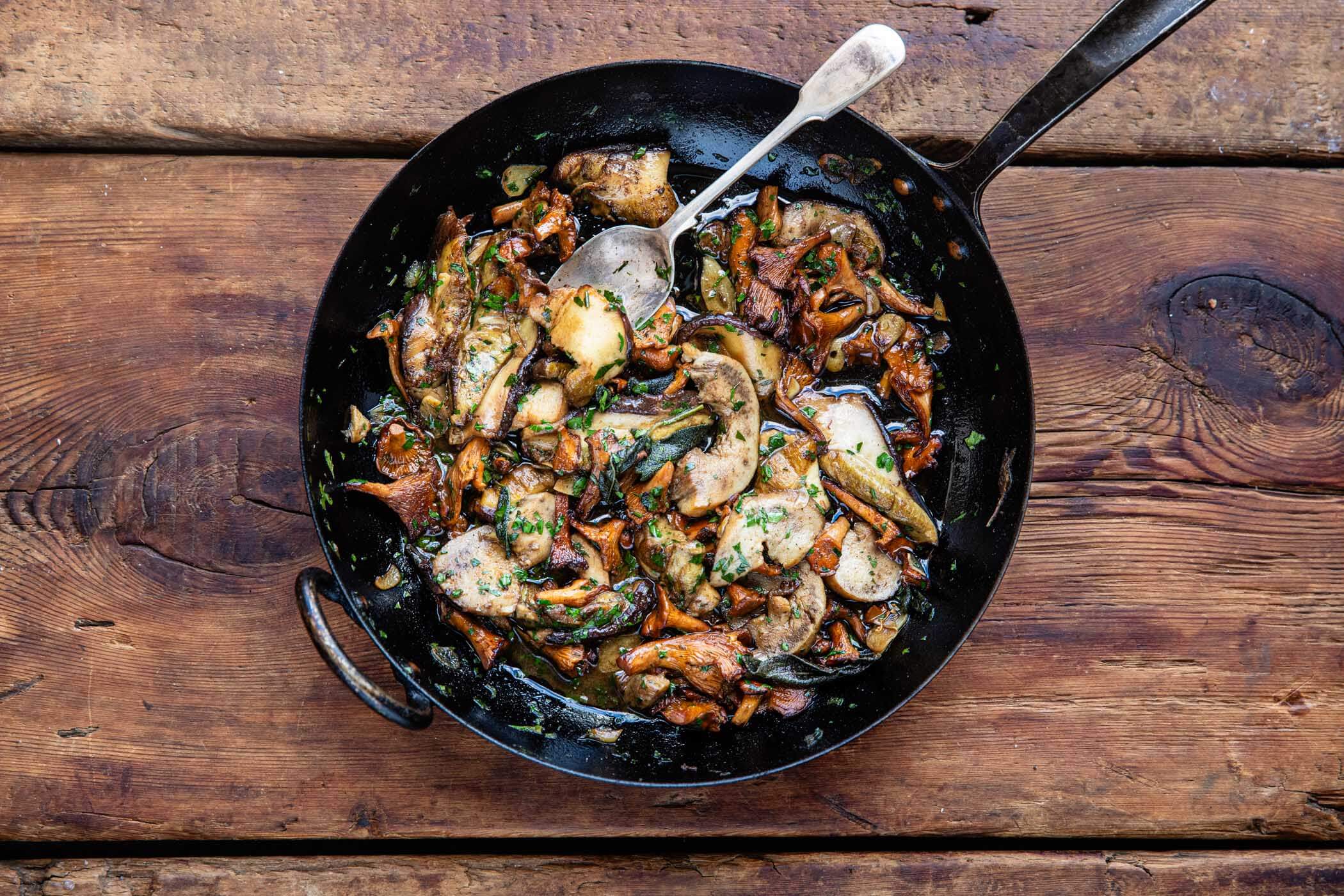
Golden girolles and ceps sautéed in a cast-iron skillet with butter, garlic and parsley

How to Cook Wild Mushrooms: Autumn is the best time of year for foraging wild mushrooms in the UK. The combination of wet yet still mild weather and lowering ground temperatures creates perfect conditions for mushrooms to spawn and grow. Predominantly found in woodland, forests and occasionally fields, there are hundreds of varieties native to the UK, many of which are not edible. Of the edible varieties, a handful stand out for flavour, so keep an eye out for ceps (also known as penny buns or porcini), girolles, grey and black chanterelles, hen of the woods, beefsteak and morels. If you are planning to forage, please do your research and be certain you know what you are looking for. Wild mushrooms are also available from good greengrocers.

They are a true seasonal gem and, if you are lucky enough to have them in the kitchen, you have myriad options for how to use them. Before you start cooking, a little prep and cleaning helps. Two bits of kit make life easier: a paring knife and a mushroom brush. First, use the paring knife to cut away any dirt from the base of the stems, then scrape any dirt from the stem. Turn the mushroom upside down and use the brush to remove any dirt from the gills, brushing in the same direction as the gills and away from the mushroom. Continue with the brush to remove any remaining dirt from the cap.

In the case of morels, or very dirty mushrooms of any variety, give them a very quick rinse in cold water. Mushrooms behave like sponges, so do not let them soak. Fill a bowl or container with cold water and briefly drop the mushrooms in, agitate with your fingers, then lift out onto kitchen paper or a clean cloth.

Wild mushrooms offer plenty of cooking options. They can be sautéed or fried, braised or poached, pickled or marinated, and even eaten raw. The method below outlines what is likely the most common preparation: sautéing.

How to Sauté Wild Mushrooms

  1. Cut the mushrooms into even, bite-sized pieces. Slice or halve larger mushrooms and leave the small ones whole so they cook evenly. Trim and cut into similar-sized pieces, about 1cm thick for slices.
  2. Set a heavy-based frying pan or cast-iron skillet over a medium to medium-high heat and add a glug of oil and a knob of butter. When the butter is foaming and lightly nut-brown, add the mushrooms in batches as necessary. Season with a little fine sea salt and shake the pan so they are evenly spread.
  3. Cook in the foaming butter for 90 seconds without moving the pan to achieve browning. Toss or turn the mushrooms and cook for a further 60–90 seconds until golden and caramelised at the edges.
  4. Check the seasoning and adjust as necessary. If you like, add sliced garlic and chopped parsley for the final 30 seconds, then finish with a squeeze of lemon or a spoon of the browned butter.

Top Tips for Sautéing Wild Mushrooms

  • Don’t crowd the pan. For proper browning and caramelisation, work in batches. If the pan is crowded, the heat drops, the mushrooms release moisture and end up poaching and turning slimy.
  • Keep the heat up. You want the butter foaming and lightly browned, not dark and never burning. Adjust the hob rather than letting the pan smoke.
  • Minimal tossing. Too much movement makes mushrooms break up and lose texture. Let colour develop, then turn once.
  • Finish with flavour. Once nicely coloured, add sliced garlic, chopped parsley and a squeeze of lemon. Or try a splash of Marsala, a glug of cream and a little chopped tarragon. They’re also lovely left simply, with a spoon of the browned butter from the pan.

Other Ideas for Cooking Wild Mushrooms

  • Mushroom fritti. Sliced porcini (cep) deep-fried in a light tempura batter is a lovely thing.
  • Simple broths. Chanterelles and morels dropped into simmering stock create a wonderful broth, ready for pasta or spätzle.
  • Baked with cream. Mushrooms baked with cream, garlic and a little white wine are decadent and delicious.
  • Quick pickles. Very fresh girolles in a light, delicate pickling liquor, jarred, make a treat in a couple of months.
  • Drying and storing. For preserving, wild mushrooms dry brilliantly. Use a very low fan oven for 24 hours, or a dehydrator if you have one. Once dried they keep for months and perk up many a dish or stock.
  • Stews and braises. Added to a stew or braise, they provide a lovely background note. Think boeuf bourguignon or coq au Riesling.

Best Meat Pairings for Wild Mushrooms

Wild mushrooms pair naturally with beef, chicken, pork and game, their earthy richness enhancing each with deep, savoury flavour. They work beautifully in steak sauces, creamy chicken dishes, pork chops with mushrooms, and slow-cooked game stews.

For a great example of this classic pairing, see George Ryle’s Bavette Steak with Ceps, Garlic & Parsley, a simple autumnal recipe where buttery golden ceps meet juicy, medium-rare bavette. It’s a dish that shows how well wild mushrooms like ceps, girolles and chanterelles complement the flavour of heritage breed beef.

Whether pan-fried, roasted or braised, wild mushrooms bring an unmistakable umami depth to meat dishes throughout the season.

Order meat online

Instagram

  • Kindred spirits. Hot pans. Spiced mutton.
Swaledale x Canton Arms supper.
Wednesday 25 February.
To book email Thecantonarms@gmail.com

@cantonarms
  • Winter and its cold hands have us fully in a tight embrace right now. And so we find ourselves cooking more often than not, to warm our souls.

A ham at the weekend is one such thing that does the job. It can be used for all kinds of dishes and provide your weekdays with a plethora of fine sandwiches. But this fine cut also produces something else. An excellent, warming stock that should not be thrown away.

In fact, it should be used to make something just as special. A deep, hearty split pea and ham soup. And here is @grylos showing you how to do it. Like most things, if you cook with time and consideration, the by-product is often just as good as the main event.
  • Ask yourself this. When did you last have a really good pork chop?

This is why we keep coming back to it. Native, rare breed pork. Dry aged on the bone. Proper depth of flavour. Nothing like the pale, wet stuff you see elsewhere.

These are our Pork Chops with Rosemary and Anchovy Butter. Two thick, rindless chops. Two discs of handmade compound butter. Anchovy, rosemary, lemon zest, a little shallot. Old friends. It works.
  • Fancy a bit of a butcher’s tip? Or a hack, if you will. Well look no further. 

Here, @grylos, gets creative with a joint of boned and rolled beef rump, creating three, totally different meals, from the one piece of meat. A great example of some leftfield thinking and the perfect way to add a little variety into your weekly meal planning. Along the spectrum from raw to medium, your week could go a little something like this; tartare and toast lightly rubbed with garlic for lunch on Wednesday; steak night on Friday night, with chips, good red wine and a bowl of bearnaise; a roast dinner on Sunday. Bob’s your uncle, Fanny’s your aunt and a carnivorous and hugely satisfying week of eating is complete. 

All that from a single rolled rump of beef! A life hack if I ever saw one…

Did you know that our rumps won 3 stars at the Great Taste Awards? 3-star rump, you can’t argue with that!
  • Do you love bacon?

Here’s our in house science and history teacher, @grylos, talking osmosis, salt, and the slow work of dry curing bacon.
  • Burns Night, 25 January.

Two pastry wrapped tributes to Robert Burns.
Made with chef Josh Whitehead of @finer_pleasures.

A haggis sausage roll with coarse cut native breed pork.
A hot water crust pie of mutton and lamb haggis, oats, onions and spice.

Food for a cold night.
  • On many a recipe, the instruction ‘brown your mince’ is set out plainly enough. And yet, deep into January, when slow cooking is very much back on the table and recipes keep asking for the same thing, it feels worth saying that this is meant quite literally. Brown your mince. It does not say grey it.

Browning is a process, not a gesture. It takes time, heat, and a little patience, and what you are doing is building flavour, not simply warming meat through. When mince is rushed, crowded into the pan, stirred too soon, it stews. It turns grey. The moisture stays put and the flavour never quite arrives.

So here is @grylos , taking a moment to explain the difference, and to remind you that if you want the most from good produce, you have to let it work. Give it space. Leave it alone long enough to colour properly. Let it smell right before you move on.

Because this is slow food month, after all. There is no need to hurry. Take your time, do it properly, and you will taste the difference in the finished dish.
  • Winter. It felt strange being in Yorkshire, watching the news from the south where snow lay thick and sudden, while here January had arrived quietly, cold and wet, but not yet truly winter as we know it. Up here the season has always moved at a slower pace, and there is something steadying in remembering that. The idea that we should charge straight on after Christmas is a modern one, and it sits awkwardly with bodies and minds that are still tuned to pause, to take stock, to look back at the year just gone. 

Out on the farms, there is no rush but plenty to do. Some are already lambing, others preparing for it, working with the land rather than against it as the days begin, almost imperceptibly, to lengthen. The fields are still subdued, but there are signs, if you look closely, that life is beginning to stir again.

And so, it feels right, now and then, to slow everything down and simply notice Yorkshire in January, not as something to be endured, but as a quiet and beautiful part of the year in its own right.
Kindred spirits. Hot pans. Spiced mutton. Swaledale x Canton Arms supper. Wednesday 25 February. To book email Thecantonarms@gmail.com @cantonarms
21 hours ago
712
View on Instagram |
1/8
Winter and its cold hands have us fully in a tight embrace right now. And so we find ourselves cooking more often than not, to warm our souls. A ham at the weekend is one such thing that does the job. It can be used for all kinds of dishes and provide your weekdays with a plethora of fine sandwiches. But this fine cut also produces something else. An excellent, warming stock that should not be thrown away. In fact, it should be used to make something just as special. A deep, hearty split pea and ham soup. And here is @grylos showing you how to do it. Like most things, if you cook with time and consideration, the by-product is often just as good as the main event.
6 days ago
13416
View on Instagram |
2/8
Ask yourself this. When did you last have a really good pork chop?

This is why we keep coming back to it. Native, rare breed pork. Dry aged on the bone. Proper depth of flavour. Nothing like the pale, wet stuff you see elsewhere.

These are our Pork Chops with Rosemary and Anchovy Butter. Two thick, rindless chops. Two discs of handmade compound butter. Anchovy, rosemary, lemon zest, a little shallot. Old friends. It works.
Ask yourself this. When did you last have a really good pork chop?

This is why we keep coming back to it. Native, rare breed pork. Dry aged on the bone. Proper depth of flavour. Nothing like the pale, wet stuff you see elsewhere.

These are our Pork Chops with Rosemary and Anchovy Butter. Two thick, rindless chops. Two discs of handmade compound butter. Anchovy, rosemary, lemon zest, a little shallot. Old friends. It works.
Ask yourself this. When did you last have a really good pork chop? This is why we keep coming back to it. Native, rare breed pork. Dry aged on the bone. Proper depth of flavour. Nothing like the pale, wet stuff you see elsewhere. These are our Pork Chops with Rosemary and Anchovy Butter. Two thick, rindless chops. Two discs of handmade compound butter. Anchovy, rosemary, lemon zest, a little shallot. Old friends. It works.
2 weeks ago
472
View on Instagram |
3/8
Fancy a bit of a butcher’s tip? Or a hack, if you will. Well look no further. Here, @grylos, gets creative with a joint of boned and rolled beef rump, creating three, totally different meals, from the one piece of meat. A great example of some leftfield thinking and the perfect way to add a little variety into your weekly meal planning. Along the spectrum from raw to medium, your week could go a little something like this; tartare and toast lightly rubbed with garlic for lunch on Wednesday; steak night on Friday night, with chips, good red wine and a bowl of bearnaise; a roast dinner on Sunday. Bob’s your uncle, Fanny’s your aunt and a carnivorous and hugely satisfying week of eating is complete. All that from a single rolled rump of beef! A life hack if I ever saw one… Did you know that our rumps won 3 stars at the Great Taste Awards? 3-star rump, you can’t argue with that!
2 weeks ago
2555
View on Instagram |
4/8
Do you love bacon? Here’s our in house science and history teacher, @grylos, talking osmosis, salt, and the slow work of dry curing bacon.
3 weeks ago
3498
View on Instagram |
5/8
Burns Night, 25 January.

Two pastry wrapped tributes to Robert Burns.
Made with chef Josh Whitehead of @finer_pleasures.

A haggis sausage roll with coarse cut native breed pork.
A hot water crust pie of mutton and lamb haggis, oats, onions and spice.

Food for a cold night.
Burns Night, 25 January.

Two pastry wrapped tributes to Robert Burns.
Made with chef Josh Whitehead of @finer_pleasures.

A haggis sausage roll with coarse cut native breed pork.
A hot water crust pie of mutton and lamb haggis, oats, onions and spice.

Food for a cold night.
Burns Night, 25 January.

Two pastry wrapped tributes to Robert Burns.
Made with chef Josh Whitehead of @finer_pleasures.

A haggis sausage roll with coarse cut native breed pork.
A hot water crust pie of mutton and lamb haggis, oats, onions and spice.

Food for a cold night.
Burns Night, 25 January.

Two pastry wrapped tributes to Robert Burns.
Made with chef Josh Whitehead of @finer_pleasures.

A haggis sausage roll with coarse cut native breed pork.
A hot water crust pie of mutton and lamb haggis, oats, onions and spice.

Food for a cold night.
Burns Night, 25 January.

Two pastry wrapped tributes to Robert Burns.
Made with chef Josh Whitehead of @finer_pleasures.

A haggis sausage roll with coarse cut native breed pork.
A hot water crust pie of mutton and lamb haggis, oats, onions and spice.

Food for a cold night.
Burns Night, 25 January.

Two pastry wrapped tributes to Robert Burns.
Made with chef Josh Whitehead of @finer_pleasures.

A haggis sausage roll with coarse cut native breed pork.
A hot water crust pie of mutton and lamb haggis, oats, onions and spice.

Food for a cold night.
Burns Night, 25 January. Two pastry wrapped tributes to Robert Burns. Made with chef Josh Whitehead of @finer_pleasures. A haggis sausage roll with coarse cut native breed pork. A hot water crust pie of mutton and lamb haggis, oats, onions and spice. Food for a cold night.
3 weeks ago
1166
View on Instagram |
6/8
On many a recipe, the instruction ‘brown your mince’ is set out plainly enough. And yet, deep into January, when slow cooking is very much back on the table and recipes keep asking for the same thing, it feels worth saying that this is meant quite literally. Brown your mince. It does not say grey it. Browning is a process, not a gesture. It takes time, heat, and a little patience, and what you are doing is building flavour, not simply warming meat through. When mince is rushed, crowded into the pan, stirred too soon, it stews. It turns grey. The moisture stays put and the flavour never quite arrives. So here is @grylos , taking a moment to explain the difference, and to remind you that if you want the most from good produce, you have to let it work. Give it space. Leave it alone long enough to colour properly. Let it smell right before you move on. Because this is slow food month, after all. There is no need to hurry. Take your time, do it properly, and you will taste the difference in the finished dish.
4 weeks ago
2787
View on Instagram |
7/8
Winter. It felt strange being in Yorkshire, watching the news from the south where snow lay thick and sudden, while here January had arrived quietly, cold and wet, but not yet truly winter as we know it. Up here the season has always moved at a slower pace, and there is something steadying in remembering that. The idea that we should charge straight on after Christmas is a modern one, and it sits awkwardly with bodies and minds that are still tuned to pause, to take stock, to look back at the year just gone. 

Out on the farms, there is no rush but plenty to do. Some are already lambing, others preparing for it, working with the land rather than against it as the days begin, almost imperceptibly, to lengthen. The fields are still subdued, but there are signs, if you look closely, that life is beginning to stir again.

And so, it feels right, now and then, to slow everything down and simply notice Yorkshire in January, not as something to be endured, but as a quiet and beautiful part of the year in its own right.
Winter. It felt strange being in Yorkshire, watching the news from the south where snow lay thick and sudden, while here January had arrived quietly, cold and wet, but not yet truly winter as we know it. Up here the season has always moved at a slower pace, and there is something steadying in remembering that. The idea that we should charge straight on after Christmas is a modern one, and it sits awkwardly with bodies and minds that are still tuned to pause, to take stock, to look back at the year just gone. 

Out on the farms, there is no rush but plenty to do. Some are already lambing, others preparing for it, working with the land rather than against it as the days begin, almost imperceptibly, to lengthen. The fields are still subdued, but there are signs, if you look closely, that life is beginning to stir again.

And so, it feels right, now and then, to slow everything down and simply notice Yorkshire in January, not as something to be endured, but as a quiet and beautiful part of the year in its own right.
Winter. It felt strange being in Yorkshire, watching the news from the south where snow lay thick and sudden, while here January had arrived quietly, cold and wet, but not yet truly winter as we know it. Up here the season has always moved at a slower pace, and there is something steadying in remembering that. The idea that we should charge straight on after Christmas is a modern one, and it sits awkwardly with bodies and minds that are still tuned to pause, to take stock, to look back at the year just gone. 

Out on the farms, there is no rush but plenty to do. Some are already lambing, others preparing for it, working with the land rather than against it as the days begin, almost imperceptibly, to lengthen. The fields are still subdued, but there are signs, if you look closely, that life is beginning to stir again.

And so, it feels right, now and then, to slow everything down and simply notice Yorkshire in January, not as something to be endured, but as a quiet and beautiful part of the year in its own right.
Winter. It felt strange being in Yorkshire, watching the news from the south where snow lay thick and sudden, while here January had arrived quietly, cold and wet, but not yet truly winter as we know it. Up here the season has always moved at a slower pace, and there is something steadying in remembering that. The idea that we should charge straight on after Christmas is a modern one, and it sits awkwardly with bodies and minds that are still tuned to pause, to take stock, to look back at the year just gone. Out on the farms, there is no rush but plenty to do. Some are already lambing, others preparing for it, working with the land rather than against it as the days begin, almost imperceptibly, to lengthen. The fields are still subdued, but there are signs, if you look closely, that life is beginning to stir again. And so, it feels right, now and then, to slow everything down and simply notice Yorkshire in January, not as something to be endured, but as a quiet and beautiful part of the year in its own right.
1 month ago
712
View on Instagram |
8/8