How-To Guides

How to Cook Bavette Steak

What is Bavette Steak?

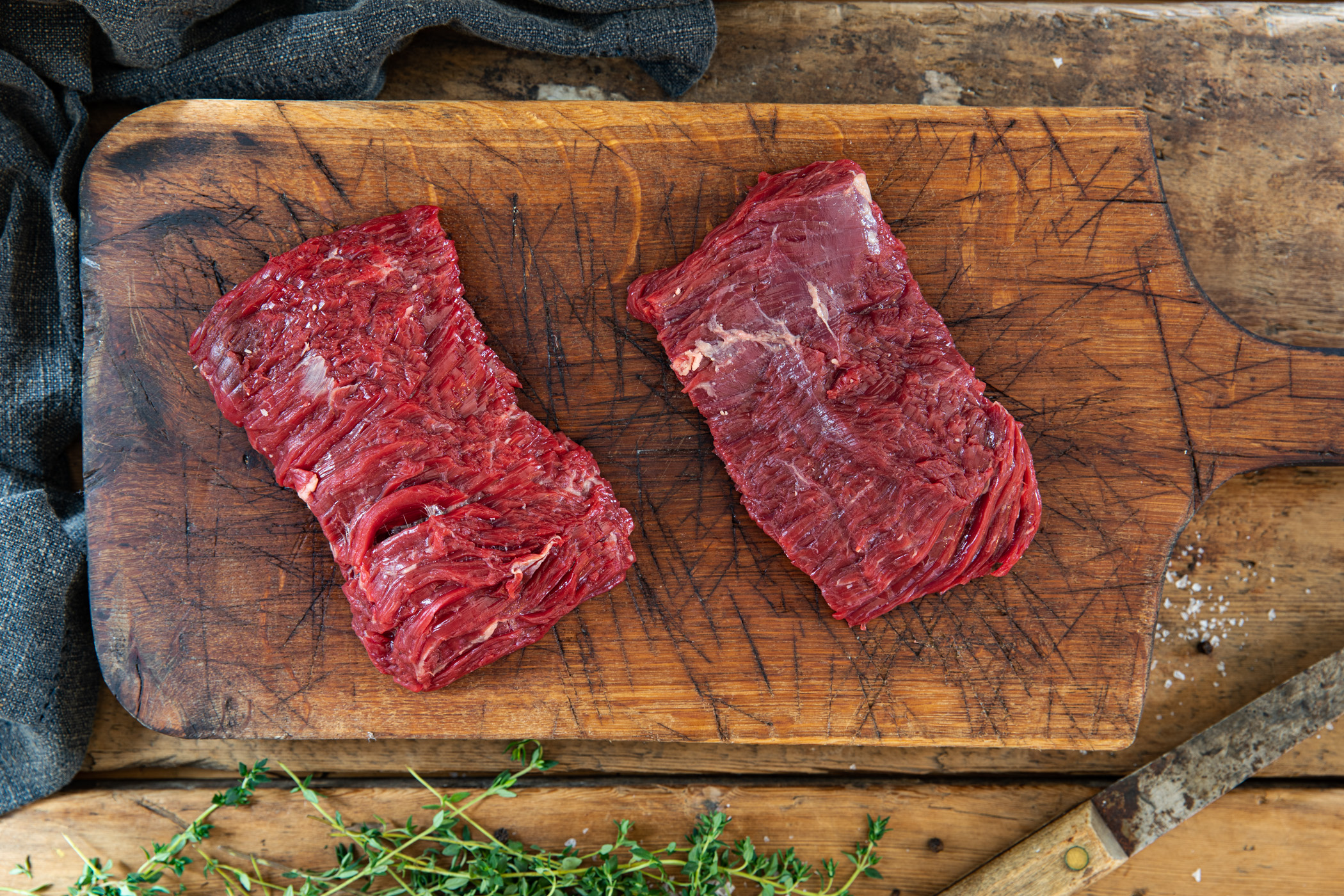
How to Cook Bavette Steak: Often referred to as the “butcher’s cut”, bavette steak has a well-earned reputation for flavour. Traditionally kept back by butchers for their own enjoyment, it’s cut from the abdominal muscles at the base of the flank – one of the most exercised parts of the animal.

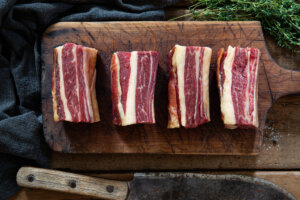
This gives bavette its distinctive, loose texture and deep, beefy flavour. High in fine intramuscular fat (marbling), it’s a richly satisfying cut that rewards quick cooking and proper slicing across the grain.

Bavette Steak Cooking Time

Bavette steak needs careful handling. If overcooked, it can become tough and chewy – the fine intramuscular fat (marbling) that gives it such flavour is also easily dried out. A quick, hot sear followed by a proper rest is key to unlocking its full potential.

Thickness can vary, so cooking times aren’t one-size-fits-all. Developing a feel for how a rare steak responds to touch is invaluable – see our top tips below.

For the best results, we recommend serving bavette steak rare. Cook for around 8–10 minutes in total, depending on thickness, then rest well before slicing against the grain.

The Best Way to Cook Bavette Steak

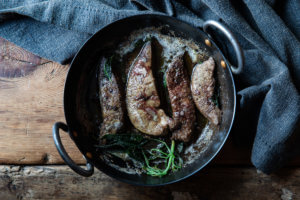
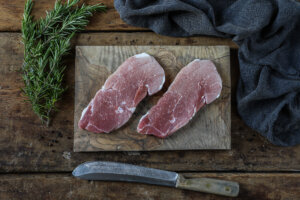
  1. Start by removing your bavette steak from the fridge and its vacuum packaging. Pat dry any surface moisture and allow it to come up to room temperature – this ensures even cooking.
  2. Heat a griddle or heavy-based frying pan until smoking hot. Just before cooking, rub a little vegetable oil over both sides of the steak and season generously with salt and pepper.
  3. Place the steak in the pan and sear for around 90 seconds per side. It will naturally release from the pan once a good crust has formed – if it sticks, give it a few more seconds before trying again.
  4. Reduce the heat slightly and continue cooking for a total of 6–8 minutes, turning the steak every 30 seconds for an even sear.
  5. Once cooked, remove from the pan and rest in a warm place for at least 8 minutes. This helps the juices redistribute, keeping the steak tender and flavourful.

Top Tips for Cooking Bavette Steak

To judge doneness, use the finger test – a quick, tactile way to check if your bavette steak is rare. Gently press the fleshy part of your palm below the thumb. Now touch the same spot while bringing your thumb to meet your index finger – that firmer feel is roughly what rare steak should feel like.

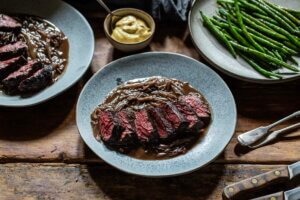
One of the most important tips for how to cook bavette steak well: always carve against the grain. Bavette has a pronounced, open grain that makes the direction easy to spot. Slicing across it shortens the muscle fibres, making each bite more tender.

More bavette steak tips:

  • Don’t skip the rest. A solid 8–10 minutes in a warm place after cooking allows juices to redistribute, keeping the meat juicy and tender.

  • Use high heat to get a proper crust, then reduce slightly to finish cooking without drying out the meat.

  • A meat thermometer can help – aim for around 50–52°C (122–125°F) for rare before resting.

  • Slice thinly, especially when serving on sharing platters or in steak salads – bavette’s bold flavour goes a long way.

Bavette Steak: Recipe & Serving Ideas

Bavette has the depth and character to stand up to bold accompaniments. Try topping your steaks with a slice of Roquefort butter or serving them with a thick, garlicky sauce like Henry Harris’ aïoli recipe. For something spicier, Sebby Holme’s Crying Tiger Steak brings heat, herbs and real vibrancy to the table.

Triple-cooked chips are a natural match – and if you’re after something sharper to cut through the richness, George Ryle’s béarnaise sauce is a fine choice. Or try our guide on how to make wild garlic mayo – punchy, vibrant, and just the thing with whole-carcass artisan steaks, roast veg or triple-cooked chips.

Order meat online

Instagram

  • On a recent trip down to London we spent time in some very good kitchens, talking to serious chefs, and the conversation kept returning to farming. Not trends or noise, but where the beef is truly coming from.

We kept bringing up the work at the Harewood House estate.

It is a project we intend to give real focus to this year, because what has been achieved there, and what continues to develop, deserves attention. On a recent visit we walked the fields with Ellen, spending time with the Highlands that many walkers know from the estate’s mires, quietly becoming unlikely stars of TikTok. Beautiful cattle, carefully and thoughtfully managed.

They have been fully outwintered and fed only on pasture. Stock levels are low, grazing is controlled, and the result is clear in their condition.

This beef is now heading into some of the most loved kitchens in the country and the response is and feedback is very good.

A short film will follow, but for now it is worth recognising the work. We look forward to sharing more from Harewood in the months ahead.
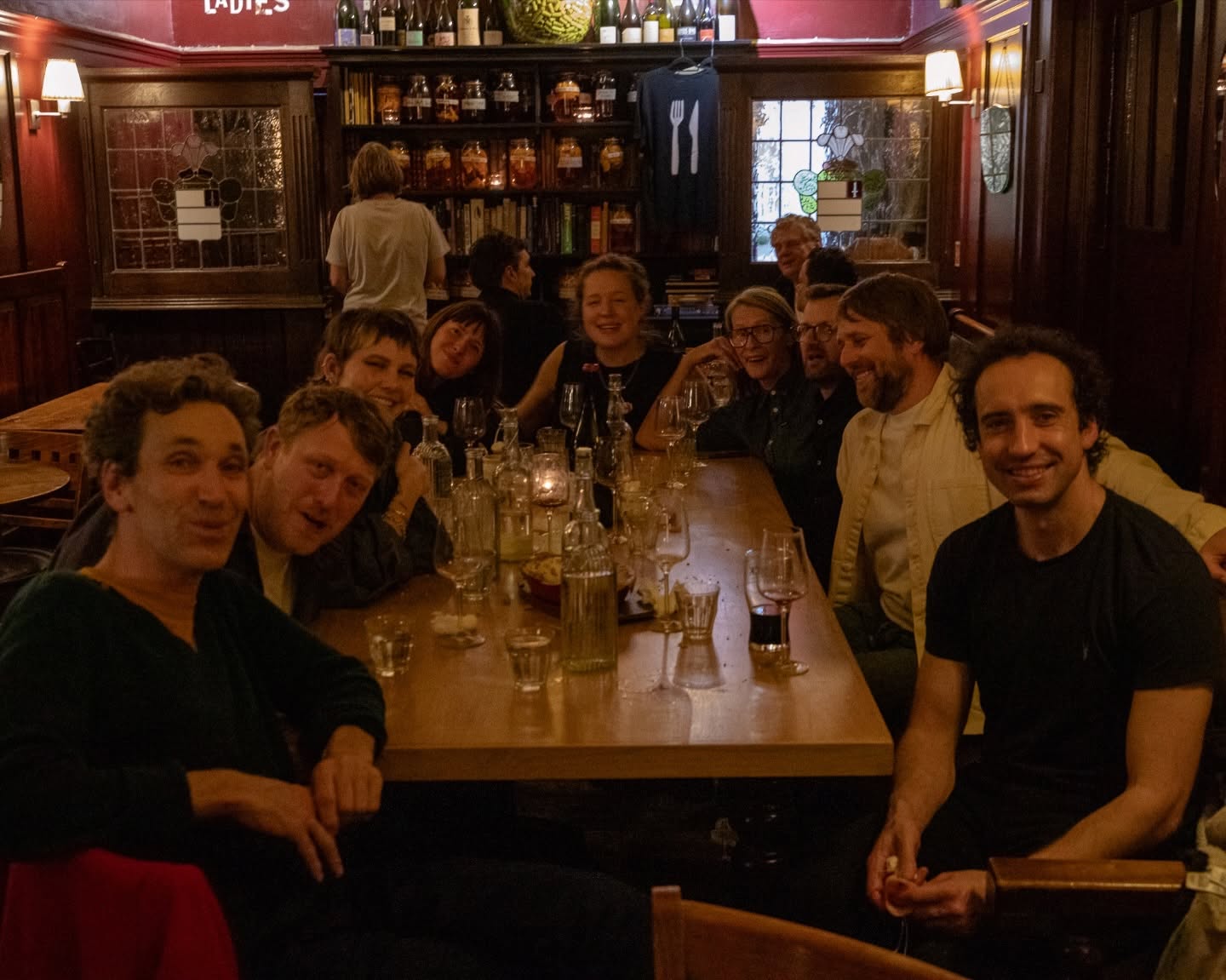
  • It’s easy to become disconnected with the restaurants and kitchens where our meat ends up being prepped, cooked and served. Whilst Instagram can give us a certain understanding of how the food looks; we all know that there is no substitute for experiencing it first-hand. And that is what we had the pleasure of doing this week at the Canton Arms. One of London’s great pubs and one of our oldest, most significant customers. We have been suppling them with exceptional meat since nearly the very beginning of the Swaledale journey. 

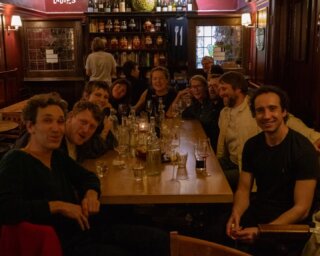
Last night was a moment to celebrate that relationship in all its glory; our meat and their cooking and outstanding hospitality coming together for what was a grand evening. We ate, we drank, we chatted in a room that was alive. Long may dining rooms like this thrive and continue to provide people with a space to consume food, booze and hospitality in such a joyous way. 

It was a special night for us, and we hope for everyone who was there. 

Thanks to @chargieb , @cantontrish, @petea25 and the @cantonarms team for being total legends xx

Ps sorry for not getting any decent pics of the food! Was having too much fun.
  • We have all seen the videos. A chicken arrives. Five neat strokes of a knife. It falls apart as if by magic. That comes from thirty years at the block. Most of us do not have that.

So here is a slightly more Radio 4 approach.

A calm, sensible way to take a good chicken and break it down at home. Nothing flashy. Just understanding the joints, working with the bone, and giving each part the respect it deserves. When you do that, you open up a week (almost) of meals. Breasts cooked one way. Legs another. A carcass that becomes stock rather than waste. More on that to follow.

The only things you truly need are a great chicken and a proper knife. Ours is a beautiful honsuki knife kindly supplied by @kitchenprovisions and it does the job expertly. Sharp. Balanced. Delightful.

Watch along as @grylos talks it through.
  • Mutton has earned itself an unfair reputation. For centuries it was simply the meat we ate. Lamb is, in many ways, the modern preference, made possible by refrigeration and global trade. Before that shift, it would have made little sense to slaughter an animal before it had lived fully and bred. Sheep were kept for wool and continuity, and when their working life was complete, they became mutton.

It was part of a cycle. Practical and sustaining. What changed was not the meat, but our habits.

Yet not all mutton is equal. Age alone does not create depth. Mutton reflects the life it has lived. When sheep are kept longer and allowed to graze widely on varied forage, moorland grasses and herbal leys, time and terrain build complexity into the muscle and fat.

That is the mutton we favour and source. Darker, firmer and deeper in flavour, shaped by prolonged grazing on moorland such as this, just outside Skipton.

There was once a rhythm between wool on our backs and mutton on our tables. Perhaps that rhythm still makes sense.
  • Kindred spirits. Hot pans. Spiced mutton.
Swaledale x Canton Arms supper.
Wednesday 25 February.
To book email Thecantonarms@gmail.com

@cantonarms
  • Winter and its cold hands have us fully in a tight embrace right now. And so we find ourselves cooking more often than not, to warm our souls.

A ham at the weekend is one such thing that does the job. It can be used for all kinds of dishes and provide your weekdays with a plethora of fine sandwiches. But this fine cut also produces something else. An excellent, warming stock that should not be thrown away.

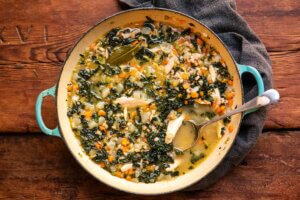
In fact, it should be used to make something just as special. A deep, hearty split pea and ham soup. And here is @grylos showing you how to do it. Like most things, if you cook with time and consideration, the by-product is often just as good as the main event.
  • Ask yourself this. When did you last have a really good pork chop?

This is why we keep coming back to it. Native, rare breed pork. Dry aged on the bone. Proper depth of flavour. Nothing like the pale, wet stuff you see elsewhere.

These are our Pork Chops with Rosemary and Anchovy Butter. Two thick, rindless chops. Two discs of handmade compound butter. Anchovy, rosemary, lemon zest, a little shallot. Old friends. It works.
  • Fancy a bit of a butcher’s tip? Or a hack, if you will. Well look no further. 

Here, @grylos, gets creative with a joint of boned and rolled beef rump, creating three, totally different meals, from the one piece of meat. A great example of some leftfield thinking and the perfect way to add a little variety into your weekly meal planning. Along the spectrum from raw to medium, your week could go a little something like this; tartare and toast lightly rubbed with garlic for lunch on Wednesday; steak night on Friday night, with chips, good red wine and a bowl of bearnaise; a roast dinner on Sunday. Bob’s your uncle, Fanny’s your aunt and a carnivorous and hugely satisfying week of eating is complete. 

All that from a single rolled rump of beef! A life hack if I ever saw one…

Did you know that our rumps won 3 stars at the Great Taste Awards? 3-star rump, you can’t argue with that!
On a recent trip down to London we spent time in some very good kitchens, talking to serious chefs, and the conversation kept returning to farming. Not trends or noise, but where the beef is truly coming from.

We kept bringing up the work at the Harewood House estate.

It is a project we intend to give real focus to this year, because what has been achieved there, and what continues to develop, deserves attention. On a recent visit we walked the fields with Ellen, spending time with the Highlands that many walkers know from the estate’s mires, quietly becoming unlikely stars of TikTok. Beautiful cattle, carefully and thoughtfully managed.

They have been fully outwintered and fed only on pasture. Stock levels are low, grazing is controlled, and the result is clear in their condition.

This beef is now heading into some of the most loved kitchens in the country and the response is and feedback is very good.

A short film will follow, but for now it is worth recognising the work. We look forward to sharing more from Harewood in the months ahead.
On a recent trip down to London we spent time in some very good kitchens, talking to serious chefs, and the conversation kept returning to farming. Not trends or noise, but where the beef is truly coming from.

We kept bringing up the work at the Harewood House estate.

It is a project we intend to give real focus to this year, because what has been achieved there, and what continues to develop, deserves attention. On a recent visit we walked the fields with Ellen, spending time with the Highlands that many walkers know from the estate’s mires, quietly becoming unlikely stars of TikTok. Beautiful cattle, carefully and thoughtfully managed.

They have been fully outwintered and fed only on pasture. Stock levels are low, grazing is controlled, and the result is clear in their condition.

This beef is now heading into some of the most loved kitchens in the country and the response is and feedback is very good.

A short film will follow, but for now it is worth recognising the work. We look forward to sharing more from Harewood in the months ahead.
On a recent trip down to London we spent time in some very good kitchens, talking to serious chefs, and the conversation kept returning to farming. Not trends or noise, but where the beef is truly coming from. We kept bringing up the work at the Harewood House estate. It is a project we intend to give real focus to this year, because what has been achieved there, and what continues to develop, deserves attention. On a recent visit we walked the fields with Ellen, spending time with the Highlands that many walkers know from the estate’s mires, quietly becoming unlikely stars of TikTok. Beautiful cattle, carefully and thoughtfully managed. They have been fully outwintered and fed only on pasture. Stock levels are low, grazing is controlled, and the result is clear in their condition. This beef is now heading into some of the most loved kitchens in the country and the response is and feedback is very good. A short film will follow, but for now it is worth recognising the work. We look forward to sharing more from Harewood in the months ahead.
17 hours ago
25
View on Instagram |
1/8
It’s easy to become disconnected with the restaurants and kitchens where our meat ends up being prepped, cooked and served. Whilst Instagram can give us a certain understanding of how the food looks; we all know that there is no substitute for experiencing it first-hand. And that is what we had the pleasure of doing this week at the Canton Arms. One of London’s great pubs and one of our oldest, most significant customers. We have been suppling them with exceptional meat since nearly the very beginning of the Swaledale journey. 

Last night was a moment to celebrate that relationship in all its glory; our meat and their cooking and outstanding hospitality coming together for what was a grand evening. We ate, we drank, we chatted in a room that was alive. Long may dining rooms like this thrive and continue to provide people with a space to consume food, booze and hospitality in such a joyous way. 

It was a special night for us, and we hope for everyone who was there. 

Thanks to @chargieb , @cantontrish, @petea25 and the @cantonarms team for being total legends xx

Ps sorry for not getting any decent pics of the food! Was having too much fun.
It’s easy to become disconnected with the restaurants and kitchens where our meat ends up being prepped, cooked and served. Whilst Instagram can give us a certain understanding of how the food looks; we all know that there is no substitute for experiencing it first-hand. And that is what we had the pleasure of doing this week at the Canton Arms. One of London’s great pubs and one of our oldest, most significant customers. We have been suppling them with exceptional meat since nearly the very beginning of the Swaledale journey. Last night was a moment to celebrate that relationship in all its glory; our meat and their cooking and outstanding hospitality coming together for what was a grand evening. We ate, we drank, we chatted in a room that was alive. Long may dining rooms like this thrive and continue to provide people with a space to consume food, booze and hospitality in such a joyous way. It was a special night for us, and we hope for everyone who was there. Thanks to @chargieb , @cantontrish, @petea25 and the @cantonarms team for being total legends xx Ps sorry for not getting any decent pics of the food! Was having too much fun.
5 days ago
1424
View on Instagram |
2/8
We have all seen the videos. A chicken arrives. Five neat strokes of a knife. It falls apart as if by magic. That comes from thirty years at the block. Most of us do not have that. So here is a slightly more Radio 4 approach. A calm, sensible way to take a good chicken and break it down at home. Nothing flashy. Just understanding the joints, working with the bone, and giving each part the respect it deserves. When you do that, you open up a week (almost) of meals. Breasts cooked one way. Legs another. A carcass that becomes stock rather than waste. More on that to follow. The only things you truly need are a great chicken and a proper knife. Ours is a beautiful honsuki knife kindly supplied by @kitchenprovisions and it does the job expertly. Sharp. Balanced. Delightful. Watch along as @grylos talks it through.
2 weeks ago
601
View on Instagram |
3/8
Mutton has earned itself an unfair reputation. For centuries it was simply the meat we ate. Lamb is, in many ways, the modern preference, made possible by refrigeration and global trade. Before that shift, it would have made little sense to slaughter an animal before it had lived fully and bred. Sheep were kept for wool and continuity, and when their working life was complete, they became mutton.

It was part of a cycle. Practical and sustaining. What changed was not the meat, but our habits.

Yet not all mutton is equal. Age alone does not create depth. Mutton reflects the life it has lived. When sheep are kept longer and allowed to graze widely on varied forage, moorland grasses and herbal leys, time and terrain build complexity into the muscle and fat.

That is the mutton we favour and source. Darker, firmer and deeper in flavour, shaped by prolonged grazing on moorland such as this, just outside Skipton.

There was once a rhythm between wool on our backs and mutton on our tables. Perhaps that rhythm still makes sense.
Mutton has earned itself an unfair reputation. For centuries it was simply the meat we ate. Lamb is, in many ways, the modern preference, made possible by refrigeration and global trade. Before that shift, it would have made little sense to slaughter an animal before it had lived fully and bred. Sheep were kept for wool and continuity, and when their working life was complete, they became mutton.

It was part of a cycle. Practical and sustaining. What changed was not the meat, but our habits.

Yet not all mutton is equal. Age alone does not create depth. Mutton reflects the life it has lived. When sheep are kept longer and allowed to graze widely on varied forage, moorland grasses and herbal leys, time and terrain build complexity into the muscle and fat.

That is the mutton we favour and source. Darker, firmer and deeper in flavour, shaped by prolonged grazing on moorland such as this, just outside Skipton.

There was once a rhythm between wool on our backs and mutton on our tables. Perhaps that rhythm still makes sense.
Mutton has earned itself an unfair reputation. For centuries it was simply the meat we ate. Lamb is, in many ways, the modern preference, made possible by refrigeration and global trade. Before that shift, it would have made little sense to slaughter an animal before it had lived fully and bred. Sheep were kept for wool and continuity, and when their working life was complete, they became mutton.

It was part of a cycle. Practical and sustaining. What changed was not the meat, but our habits.

Yet not all mutton is equal. Age alone does not create depth. Mutton reflects the life it has lived. When sheep are kept longer and allowed to graze widely on varied forage, moorland grasses and herbal leys, time and terrain build complexity into the muscle and fat.

That is the mutton we favour and source. Darker, firmer and deeper in flavour, shaped by prolonged grazing on moorland such as this, just outside Skipton.

There was once a rhythm between wool on our backs and mutton on our tables. Perhaps that rhythm still makes sense.
Mutton has earned itself an unfair reputation. For centuries it was simply the meat we ate. Lamb is, in many ways, the modern preference, made possible by refrigeration and global trade. Before that shift, it would have made little sense to slaughter an animal before it had lived fully and bred. Sheep were kept for wool and continuity, and when their working life was complete, they became mutton.

It was part of a cycle. Practical and sustaining. What changed was not the meat, but our habits.

Yet not all mutton is equal. Age alone does not create depth. Mutton reflects the life it has lived. When sheep are kept longer and allowed to graze widely on varied forage, moorland grasses and herbal leys, time and terrain build complexity into the muscle and fat.

That is the mutton we favour and source. Darker, firmer and deeper in flavour, shaped by prolonged grazing on moorland such as this, just outside Skipton.

There was once a rhythm between wool on our backs and mutton on our tables. Perhaps that rhythm still makes sense.
Mutton has earned itself an unfair reputation. For centuries it was simply the meat we ate. Lamb is, in many ways, the modern preference, made possible by refrigeration and global trade. Before that shift, it would have made little sense to slaughter an animal before it had lived fully and bred. Sheep were kept for wool and continuity, and when their working life was complete, they became mutton. It was part of a cycle. Practical and sustaining. What changed was not the meat, but our habits. Yet not all mutton is equal. Age alone does not create depth. Mutton reflects the life it has lived. When sheep are kept longer and allowed to graze widely on varied forage, moorland grasses and herbal leys, time and terrain build complexity into the muscle and fat. That is the mutton we favour and source. Darker, firmer and deeper in flavour, shaped by prolonged grazing on moorland such as this, just outside Skipton. There was once a rhythm between wool on our backs and mutton on our tables. Perhaps that rhythm still makes sense.
3 weeks ago
491
View on Instagram |
4/8
Kindred spirits. Hot pans. Spiced mutton. Swaledale x Canton Arms supper. Wednesday 25 February. To book email Thecantonarms@gmail.com @cantonarms
3 weeks ago
1526
View on Instagram |
5/8
Winter and its cold hands have us fully in a tight embrace right now. And so we find ourselves cooking more often than not, to warm our souls. A ham at the weekend is one such thing that does the job. It can be used for all kinds of dishes and provide your weekdays with a plethora of fine sandwiches. But this fine cut also produces something else. An excellent, warming stock that should not be thrown away. In fact, it should be used to make something just as special. A deep, hearty split pea and ham soup. And here is @grylos showing you how to do it. Like most things, if you cook with time and consideration, the by-product is often just as good as the main event.
4 weeks ago
14316
View on Instagram |
6/8
Ask yourself this. When did you last have a really good pork chop?

This is why we keep coming back to it. Native, rare breed pork. Dry aged on the bone. Proper depth of flavour. Nothing like the pale, wet stuff you see elsewhere.

These are our Pork Chops with Rosemary and Anchovy Butter. Two thick, rindless chops. Two discs of handmade compound butter. Anchovy, rosemary, lemon zest, a little shallot. Old friends. It works.
Ask yourself this. When did you last have a really good pork chop?

This is why we keep coming back to it. Native, rare breed pork. Dry aged on the bone. Proper depth of flavour. Nothing like the pale, wet stuff you see elsewhere.

These are our Pork Chops with Rosemary and Anchovy Butter. Two thick, rindless chops. Two discs of handmade compound butter. Anchovy, rosemary, lemon zest, a little shallot. Old friends. It works.
Ask yourself this. When did you last have a really good pork chop? This is why we keep coming back to it. Native, rare breed pork. Dry aged on the bone. Proper depth of flavour. Nothing like the pale, wet stuff you see elsewhere. These are our Pork Chops with Rosemary and Anchovy Butter. Two thick, rindless chops. Two discs of handmade compound butter. Anchovy, rosemary, lemon zest, a little shallot. Old friends. It works.
1 month ago
472
View on Instagram |
7/8
Fancy a bit of a butcher’s tip? Or a hack, if you will. Well look no further. Here, @grylos, gets creative with a joint of boned and rolled beef rump, creating three, totally different meals, from the one piece of meat. A great example of some leftfield thinking and the perfect way to add a little variety into your weekly meal planning. Along the spectrum from raw to medium, your week could go a little something like this; tartare and toast lightly rubbed with garlic for lunch on Wednesday; steak night on Friday night, with chips, good red wine and a bowl of bearnaise; a roast dinner on Sunday. Bob’s your uncle, Fanny’s your aunt and a carnivorous and hugely satisfying week of eating is complete. All that from a single rolled rump of beef! A life hack if I ever saw one… Did you know that our rumps won 3 stars at the Great Taste Awards? 3-star rump, you can’t argue with that!
1 month ago
2585
View on Instagram |
8/8