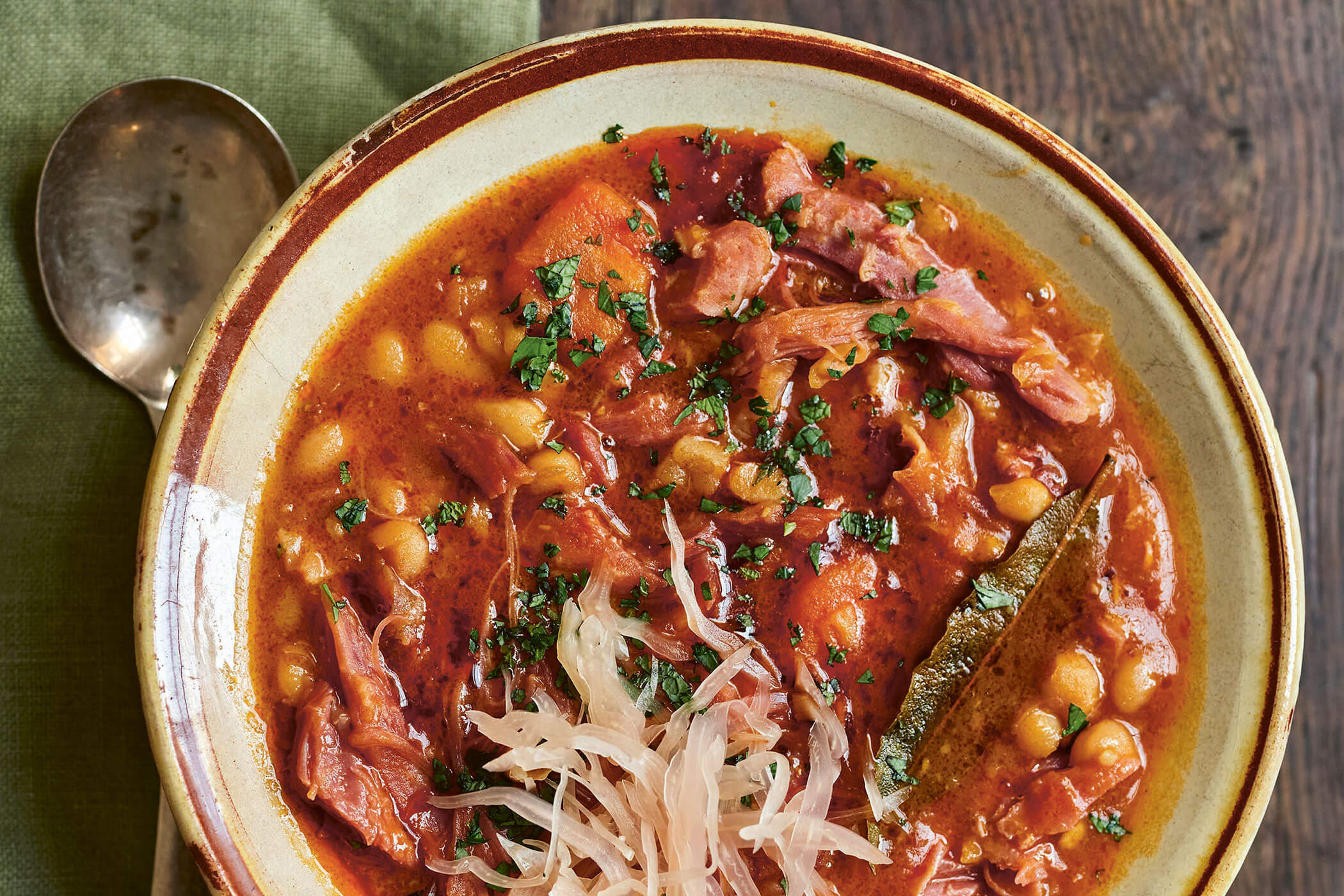
Across the Balkans, bean čorbas, or thick bean soups, range from incredibly humble and stark – such as the so-called monastery grah, grav or pasulj cooked on Eastern Orthodox fasting days, where cooked beans can be flavoured with as little as sautéed onions and perhaps mint – to the hearty and decadent – such as jota, found in northern Croatia and Slovenia, which is a stew of beans, pork, fermented cabbage and/or turnip, and in Slovenia, thick slices of Kranjska klobasa (Carniolian sausage). I grew up eating bean čorba that consisted of cooked beans flavoured with zaprška or zafrig, a kind of roux made from oil and sweet paprika, and sometimes flour, fried onions and herbs.
This version is closer to a Slovenian-style jota, minus the Carniolian sausage, though do use that in lieu of the slanina* and ham hock if you can find it. Really, after cooking the beans, you can flavour it however you like, and I encourage you to make your own Balkan-inspired bean čorba.
*Slanina is a Balkan-style salt-cured and dried, or salt-cured and smoked pork belly or pork fatback. It can be simply salted, or flavoured with various spices and aromatics such as garlic, black pepper and sweet paprika. Slanina is often thinly sliced and eaten as a savoury snack or appetiser, but it is also used extensively in baking and cooking.
This recipe is by Irina Janakievska and is kindly reproduced with her permission from The Balkan Kitchen.
Serves: 6-8
Prep time: 20 minutes
Cook time: 2 hours 30 minutes
Ingredients
Method
- Put the beans and bicarbonate of soda into a large, heavy-based saucepan or stockpot and cover with water. Set aside to soak for at least 8 hours, or overnight.
- Drain and cover with water again, then place the saucepan over a medium-high heat and bring to the boil. After 10–15 minutes, you should have a lot of scum on the top. Drain the beans again and rinse them under running water. Set aside.
- Preheat the oven to 180°C fan (400°F).
- Heat the oil in a large cast-iron casserole dish (Dutch oven) over a medium-high heat and add the onion. Fry for 5–7 minutes, or until soft and light brown, then add the garlic and cook for 30 seconds. Add the slanina, paprika, tomato purée and vegetable powder and stir to coat.
- Remove from the heat and add the drained beans, bay leaves, thyme, juniper berries, carrots, and a generous grind of black pepper and stir to combine, then nestle the ham hock among the beans. Pour in the fresh 3 litres (100 fl oz/12½ cups) water (or more to ensure everything is submerged), cover with a lid and transfer to the oven.
- Cook for 3½–4 hours, stirring occasionally and topping up with a splash of water if you need to, until the meat is falling off the ham hock.
- Remove the ham hock from the dish and place it on a large plate to cool. When cool enough to handle, peel off the skin and any excess fat and gristle and discard. Pick off all the meat and shred it roughly with your hands.
- Return the meat to the dish, along with half the sour cabbage and the herbs. Stir to incorporate. Discard the bones.
- Check and adjust the seasoning to your taste, bearing in mind the combination of ham hock and sour cabbage will be quite salty. Serve topped with more sour cabbage and sprinkled with Aleppo pepper and fresh soft herbs.