How to BBQ Right: Val’s Tips for Cooking Over Fire

How to BBQ Right: I strongly feel that the barbecue is a discipline, and when done well can produce sensational results. Swaledale produces some of the very best sausages and well fatted steak burgers known to mankind. I love such simplicity, and a great burger, well grilled, can be a divine experience. However let me take you and your barbecue to a whole other dimension, there is so much more to experiment with and enjoy…

Firstly, a barbecue is a pleasure that shouldn’t be limited just to the summer season. I’ve never understood why our grills are packed back into the furthest corner of the garage as soon as the first leaves begin to fall. Guaranteed, I can be found tongs in one hand, umbrella in the other, or even prodding a côte de boeuf in snow flecked mittens. I’m giving you permission to cook around the calendar, join me and get your 365 day glow on.
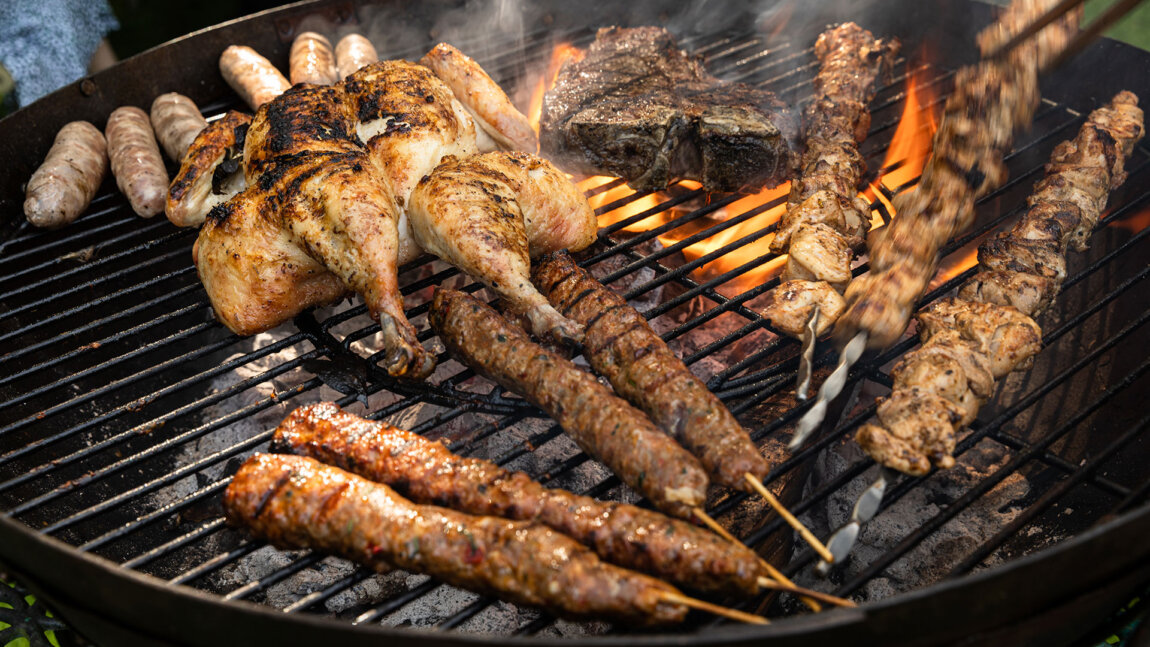
I believe that real barbecue is about wood or charcoal, the smoke being a key ingredient. A gas grill is really no different to wheeling your cooker into the garden, and where is the challenge in that? I always gravitate towards the glowing embers, they’re what create the magic and set your taste buds alight

Now let’s talk about lids. I’d like to stress that the lid of your barbecue is far more useful than a fatal swimming pool for dozy wasps. It’s time to open your mind to all sorts of possibilities, as under the lid and a lot more can be achieved beyond burgers and sausages. The use of a lid will allow the cooking of large joints and whole birds, turning your grill into more of an oven. So use a lid when required, fiddle with the vents, control the temperature and learn to use the barbecue as a closed unit.

So what BBQ should you buy? Well one with a lid for starters. They range from tens of pounds to a few thousand, but I feel it unwise to mention specific brands other than to say don’t pay for the label necessarily. The difference between an insulated BBQ, and one made of a thinner metal is heat retention and the ability to do more controlled long cooks; so I’d definitely go for something well insulated. If you’re feeding a crowd or like to grill large pieces of meat or whole fish then go large – but perhaps not American large.

Wood or charcoal? Keeping the explanation simple, wood carries more flavour, while charcoal has a more even burn but will not smoke meat with as much character. I use both, the charcoal for backing up the heat, the wood for the flavouring. Beech, apple and cherry are solid choices, I also like juniper with its strong almost incense like smoke, for finishing. Old grapevine wood, if you can get it, is wonderful too. My favourite to cook over has to be seasoned silver birch wood, which burns well and evenly, and its bark is a natural fire lighter which is very handy.
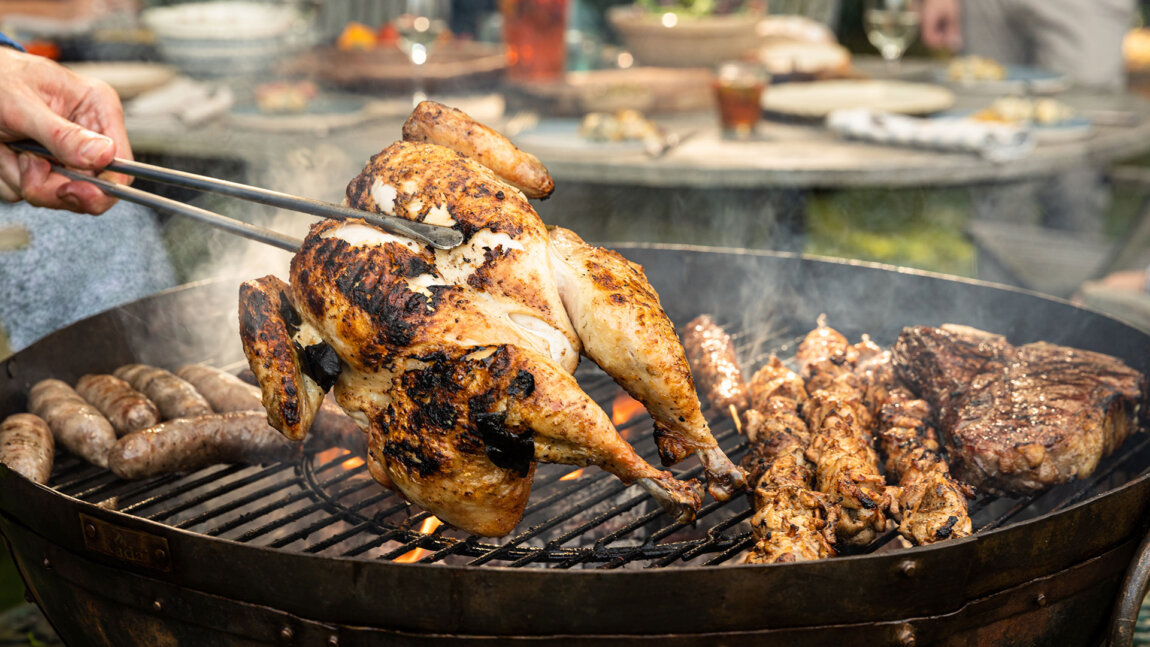
Lighting wood. If the silver birch bark peels freely from the log then strips of this will ignite immediately on contact with a flame. Take the burning bark to the edge of your split logs so that it catches, lighting the round side of a log is hopeless, you need to start a fire around the edges. Alternatively if using firelighters put the birch log, or any log, bark side down to the flame as this will not only get the fire going but will burn off unwanted thick smoke before producing the cleaner heat from the wood.

When filming with the Saami in Northern Sweden, I learnt firsthand how they cut small curls of wood from the edge of a log but leave them attached. These shavings were lit and promptly set fire to the whole freeze dried log.
Lighting charcoal. I like to make a little tower of good kindling. Two pieces placed on a parallel, 4 inches apart. Place two on top at 90-degrees in the alternate direction and repeat 3 or four times. Drop scrunched paper into the middle cavity and light. It will go up quickly. 

Lighter fuel is horrid and unnecessary; please also avoid fuel-soaked charcoal and those horrible little foil BBQ trays. I only tend to use lighters or twizzlers in the rain, otherwise I like to go au naturel. 

Arrange the charcoal or wood over and around your lit kindling. Now be patient and let the fire die to an overall grey, but pulsating with orange heat from the embers. If going for a long cook I sometimes have a back up fire or fresh burning fuel to one side, but this is rare. Cooking over big flames is to be avoided.

Finishing with flavour. Branches of fresh pine, juniper or bog myrtle leaves are to be done at the end of cooking, finishing with a last billow of the desired flavour. So too, woody herbs such as bay, rosemary and thyme, or wild fennel stalks can be used to impart their special smokes.  
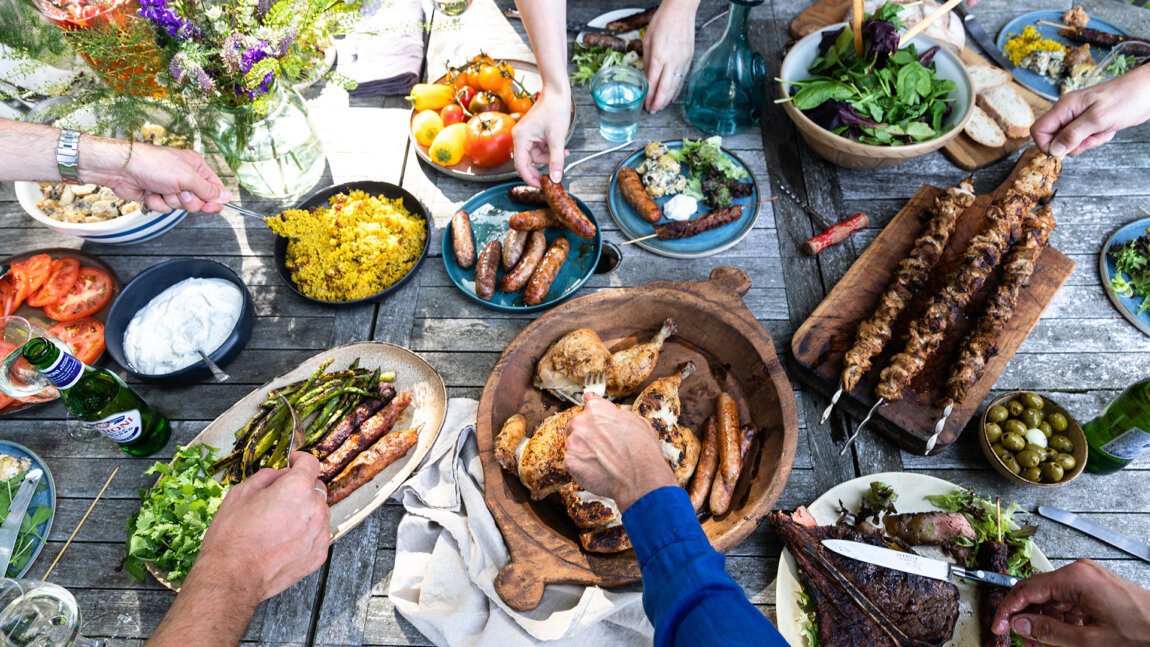
Dealing with flare ups. Handy to have close to hand is an atomiser full of water for calming heat and flare ups. Flare ups often occur if you are cooking too soon or too close. They do happen even when being careful, but they can be largely avoided by positioning meat over appropriate heat or simply moving the meat until the flame has burnt away the fat drips. If you’re cooking very fatty meat like pork or duck, then a tray under the meat is useful. Remember once the initial browning is done, your cut is better cooked low and slow so finishing meats under a lid or away from direct heat will also prevent flare up.  A mist of water will calm things should they get a bit out of hand, and the embers can also be raked around so the heat is not too intense.

So, what to cook? Just about everything! From smoky slices of sourdough toast topped with fresh anchovies and tomatoes to slow-cooked venison, smoking brisket, and whole chicken – the possibilities are endless.

Perhaps it is sensible to start with open top cooking, easy and fun items such as chicken livers and beef hearts on skewers are delightful, and only require a small fire close to the edge. Brush them with Japanese yakitori style sauces containing sake sugar and soya sauce, or maybe violent chilli or barbecue sauces. Offal is a real favourite of mine over charcoal, ox liver is fabulous when painted with sweet sharp sauces. Swaledale’s Cured Smoked Ox Tongue is amazing once sizzled over the grill, sliced and eaten with pickled walnuts and wild horseradish cream. While lamb’s kidneys and sweetbreads are simple and delicious when brushed with garlic and parsley butter. Grilled lamb sweetbreads are particularly good placed upon late summer fresh corn, cut from the cob and sautéed in butter with onion, double cream, smidgen of cumin and salt and then blitzed to a puree of primrose coloured glory. 
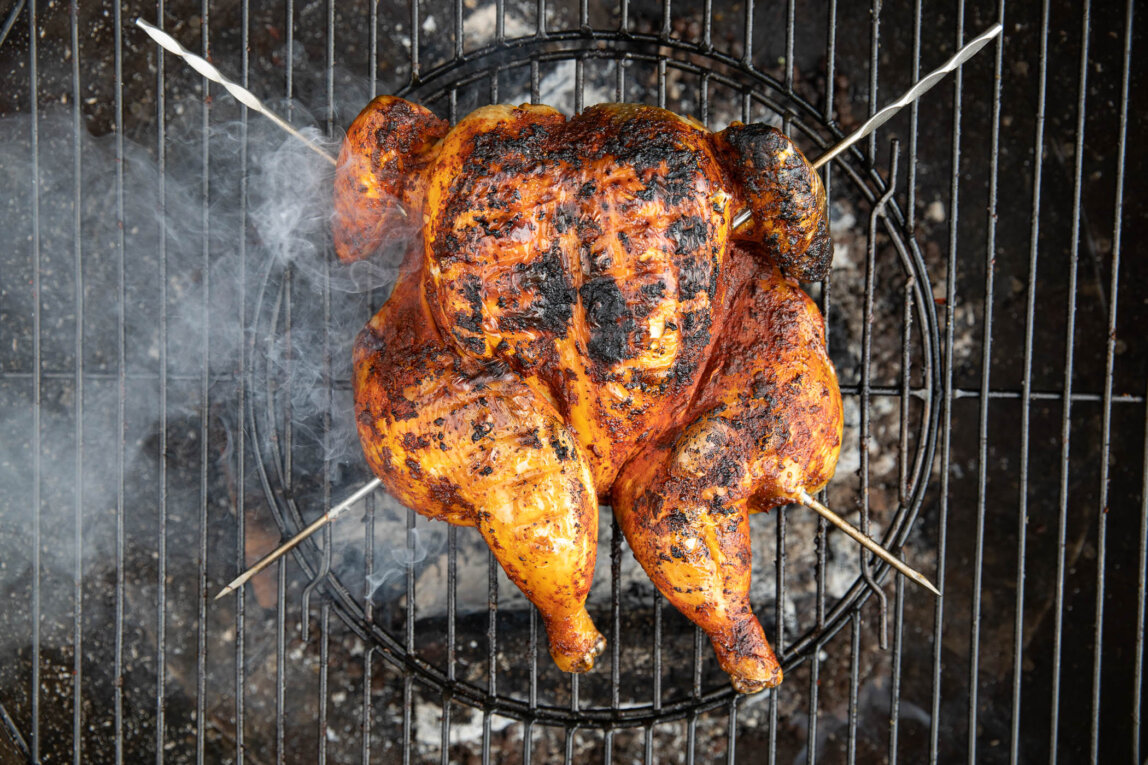
Chicken wings are a real favourite of mine and friendly on the wallet too. I particularly like them dressed with salt, chilli powder and lemon juice then grilled hard and served alongside a vivid green sauce of blitzed fresh coriander, lemon juice, olive oil, ground coriander and salt.

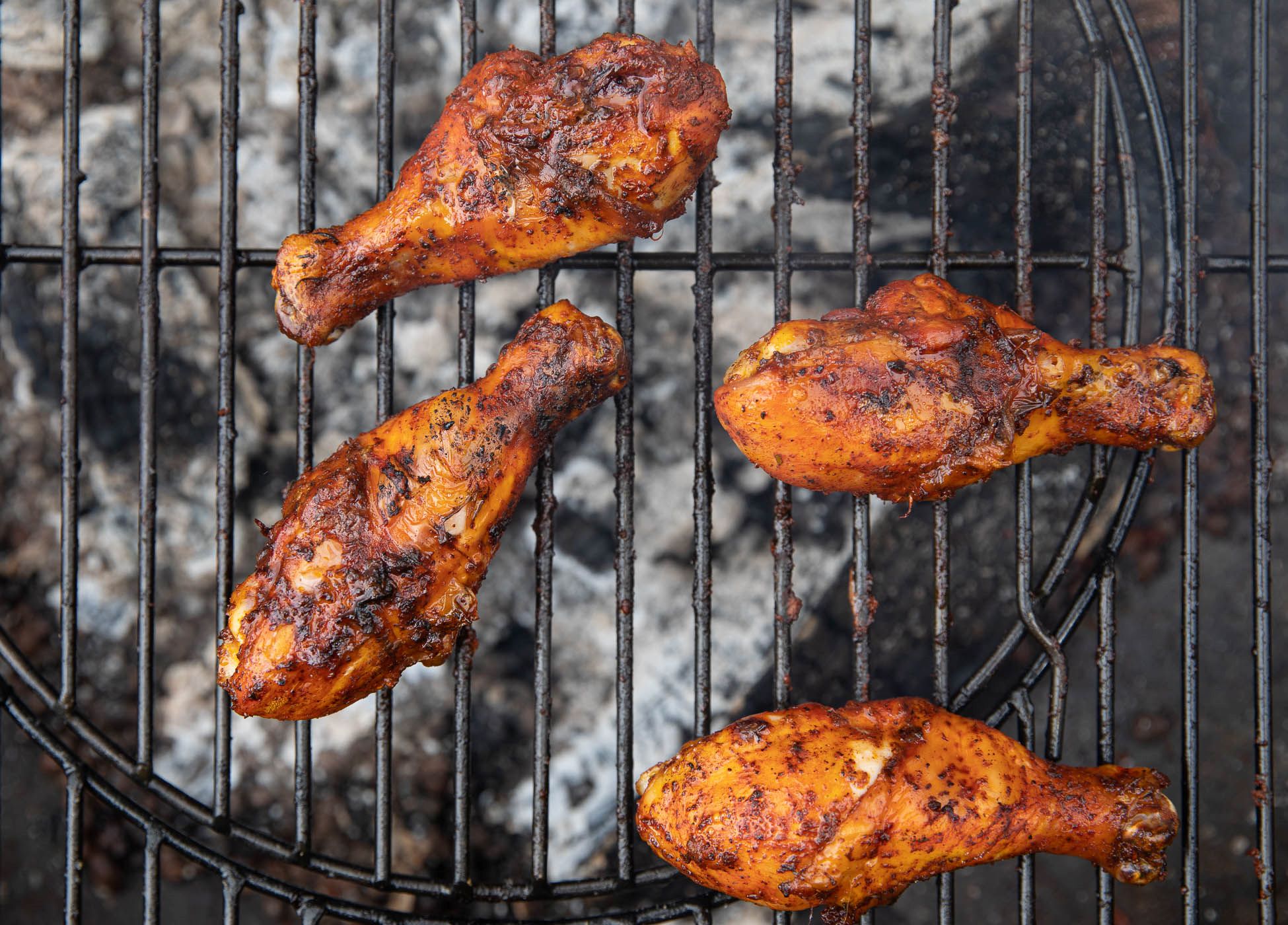
Larger pieces of meat such as steaks, pork and lamb chops can be cooked openly over the grill without a lid, but remember to cook over a more moderate fire to prevent flare ups. Some of my favourite combinations are lamb chops with oregano served with a simple Greek salad, or thick-cut rindless pork chops from the grill, served with slow cooked chard, lemon juice, olive oil, chillies and garlic. Chicken legs grilled over the fire with sage and fresh porcini are a winner too.

In terms of beef, I eat the lesser cuts as often as my favourite côte de boeuf, particularly the bavette steak which connects the belly and hind leg of the cow. Marinated in red wine, anchovies, garlic, rosemary and Dijon mustard, remember that bavette needs cooking a little longer and is better cooked to medium (rather than a chewy rare). 

The lid comes into play with larger cuts such a butterflied leg of lamb, large pieces of sirloin, rolled shoulders of pork, haunches and the like. Once the initial browning is done, then on goes the lid and the meat is cooked low and slow until the desired internal temperature is reached. When using a lid, the BBQ becomes a closed unit and the coals can be banked to one side or around the outside edge of the bowl, with the meat turned at intervals as desired. If you try to do this on an open grill, it will be a nightmare of flames, too much colour and cooking on the outside of the joint. A barbecue with a temperature dial is helpful, so too is a thermometer needle, so that you can check your meat once you think it is cooked. There is no reason to have to suffer raw chicken or overcooked sirloin.
As mentioned, pork and duck will need a tray to stop the fat dripping into the fire, and such cuts as a beef brisket, poached and painted in sweet sauce or crusted with ground coriander seeds, will need a long cooking time. 

Dirty cooking is an unfortunate term for a method I love and use often; it refers to putting the meat directly onto the wood or a hot stone to cook. It also provides wondrous results with beetroot or Jerusalem artichoke, either foil wrapped or naked, and nestled straight into the ash.  

When you’re feeling confident you can double up the cooking by placing a small ceramic pot in the bottom of the grill bowl, which means braised vegetables, stews and all sorts of wonders can be achieved while the meat cooking goes on above. This works especially well when doing a long cook and using the lid of the bbq.

While grilling is enjoyed all over the world, a few cultures and cuisines who have it down to a fine art are Argentina, Japan, Northern Spain, Mexico, India and North Africa. If you’re looking for cook books or recipe inspiration, then I would start by looking in these directions and you’ll find an abundance of flavour combinations to try.

Finally a message to the male grill chefs out there. It is an especially male prerogative to command the grill in a bossy and overly authoritarian manner, a sort of ‘UG, UG’ meat, fire and knife ‘UG’. Lots of prodding and movement. STOP! Whilst your cooking requires attention it also needs to be left alone. Get a little chair like an Ocakbasi grill chef and sit there attending only when required. Contemplate life, prod less and enjoy. 

Good luck and get your 365 day glow on.

Instagram

  • The fallacy of Spring lamb!

When we eat lamb in early April, we aren’t eating the lovely little fluffy things people see hopping about in the fields. In fact, you’re actually eating – or at least you are if you are buying from us – old season lamb. The animals that were born the previous springtime. They are age wise, on the verge of morphing into hogget and, in our opinion, it is lamb at its very best. More flavourful as the meat has developed with age, but still with the tenderness one expects with lamb. 
One thing that is not in doubt is that it pairs perfectly with a lot of the seasonal ingredients of this time of year, the peas, broad beans and courgettes from the continent, plus Jersey royals, asparagus and wild garlic from these shores. 
We have plenty of these wonderful carcasses ageing in our fridges, so embrace the idea of eating last years spring lamb!
  • A classic of French cooking, built on combinations that have stood their ground for good reason, and long may they do so.

Chicken breast roasted in brown butter, creamy mash worked with plenty of butter and dairy, and a mustard sauce brought together with cream. It reads rich, but it eats with balance. The Dijon and tarragon cut through, lifting the dish and keeping it in check.
  • A classic of French cooking, built on combinations that have stood their ground for good reason, and long may they do so.

Chicken breast roasted in brown butter, creamy mash worked with plenty of butter and dairy, and a mustard sauce brought together with cream. It reads rich, but it eats with balance. The Dijon and tarragon cut through, lifting the dish and keeping it in check.

This is food that does not chase anything. It knows exactly what it is.
  • Filmed on a blustery day at the Harewood House estate, Ellen talks us through the Highland cattle and the wider farming approach shaping the land here.

These short films look at how the estate is guiding the land back towards what it once was, using the right livestock for the right terrain and allowing systems to work with the landscape rather than against it. Hardy cattle, able to outwinter on pasture alone, reduce the need for inputs and bring a different kind of balance to the farm.

For chefs, this is where the story begins. The flavour comes later, but it is built here, in the fields, through decisions made over time rather than in a single season.

It is a strong example of thoughtful farming, where lower inputs and careful management can support both the land and a sustainable margin, all driven by a clear intention to make the estate work for nature as much as it does for people.
  • We love it when a plan comes together! And this little project with @llewelynslondon provides a great example. 

It all started with a trip up to Swaledale HQ, to see the butchery and meet the team; bacon, black pudding and egg baps were laid on fo breakfast. Then it was off to see one of our network of farmers; Jim Mallender, over in Thornton in craven. Jim and his family showed us round and held a sort of farming Q&A. Then we cooked some cuts on a bbq and sampled the llewelyns take on a hotpot. Truly bringing farmers and chef together and a wonderful day for all involved. 

Off the back of the visit a special dinner an d a three course menu of dreams. It celebrates not just our produce and their cooking but also the 6 beautiful years that head chef michael (@skinnylittlefatman) has spent at the helm of this charming restaurant. 

We are extremely excited to eat and drink tonight to celebrate all those things.
  • There might not be a food that is more of this generation than fried chicken. It’s eminently Instagram-able (or TikTok-able depending on your age), malleable to various cuisines and extremely delicious. Plus, it has just the right amount of technique, if you know what I mean. The sort of thing that, if you’re not giving it the requisite thought and attention, can be a bit ropey. No danger of that here though…

@Grylos has given it the Swaledale treatment, i.e. keeping it simple, making it delicious and showing off our incredible meat. So, with no more than a saffron aioli, some shredded iceberg and a few sliced pickles, this is the fried chicken burger of dreams! Oh, sorry, nearly forgot the crispy chicken skin – told you there was just the right amount of technique. 

There are few things that we would want to munch down for lunch more than one of these bad boys. Give ‘em a whirl!
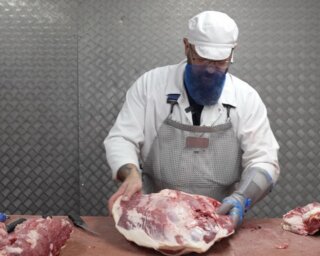
  • Always good to welcome chefs to the butchery. Earlier this week the teams from @llewelynslondon came up to see us. We showed them around the cutting room, talked through how we work, then headed up the hill for a bit of cooking and conversation.

For many chefs it is the first chance to see the whole journey. From the farms and fields where the animals are raised, through our ageing rooms, and finally into the kitchens that cook it.

If you are a chef and fancy a visit this year, you would be very welcome. Send us a message and we will put the kettle on.
  • March sits between seasons. Winter has not quite loosened its grip, and there is still time, and need, for fortifying pleasures. A bowl of chicken broth is one of them.

It begins with a proper chicken stock. Just bones and time in the pot, slowly giving up their flavour until the liquid runs clear and deeply savoury. If you watched our earlier film on how to break down a whole chicken, this is where the rest of it finds its purpose.

From there the broth is built. Pearl barley for substance. Cavolo nero and turnips for the season. Simple things, allowed to do their work in good stock.

Just before serving, a small splash of oloroso lifts the whole bowl.
The fallacy of Spring lamb! When we eat lamb in early April, we aren’t eating the lovely little fluffy things people see hopping about in the fields. In fact, you’re actually eating – or at least you are if you are buying from us – old season lamb. The animals that were born the previous springtime. They are age wise, on the verge of morphing into hogget and, in our opinion, it is lamb at its very best. More flavourful as the meat has developed with age, but still with the tenderness one expects with lamb. One thing that is not in doubt is that it pairs perfectly with a lot of the seasonal ingredients of this time of year, the peas, broad beans and courgettes from the continent, plus Jersey royals, asparagus and wild garlic from these shores. We have plenty of these wonderful carcasses ageing in our fridges, so embrace the idea of eating last years spring lamb!
1 week ago
622
View on Instagram |
1/8
A classic of French cooking, built on combinations that have stood their ground for good reason, and long may they do so. Chicken breast roasted in brown butter, creamy mash worked with plenty of butter and dairy, and a mustard sauce brought together with cream. It reads rich, but it eats with balance. The Dijon and tarragon cut through, lifting the dish and keeping it in check.
3 weeks ago
7
View on Instagram |
2/8
A classic of French cooking, built on combinations that have stood their ground for good reason, and long may they do so. Chicken breast roasted in brown butter, creamy mash worked with plenty of butter and dairy, and a mustard sauce brought together with cream. It reads rich, but it eats with balance. The Dijon and tarragon cut through, lifting the dish and keeping it in check. This is food that does not chase anything. It knows exactly what it is.
3 weeks ago
535
View on Instagram |
3/8
Filmed on a blustery day at the Harewood House estate, Ellen talks us through the Highland cattle and the wider farming approach shaping the land here. These short films look at how the estate is guiding the land back towards what it once was, using the right livestock for the right terrain and allowing systems to work with the landscape rather than against it. Hardy cattle, able to outwinter on pasture alone, reduce the need for inputs and bring a different kind of balance to the farm. For chefs, this is where the story begins. The flavour comes later, but it is built here, in the fields, through decisions made over time rather than in a single season. It is a strong example of thoughtful farming, where lower inputs and careful management can support both the land and a sustainable margin, all driven by a clear intention to make the estate work for nature as much as it does for people.
4 weeks ago
64
View on Instagram |
4/8
We love it when a plan comes together! And this little project with @llewelynslondon provides a great example. It all started with a trip up to Swaledale HQ, to see the butchery and meet the team; bacon, black pudding and egg baps were laid on fo breakfast. Then it was off to see one of our network of farmers; Jim Mallender, over in Thornton in craven. Jim and his family showed us round and held a sort of farming Q&A. Then we cooked some cuts on a bbq and sampled the llewelyns take on a hotpot. Truly bringing farmers and chef together and a wonderful day for all involved. Off the back of the visit a special dinner an d a three course menu of dreams. It celebrates not just our produce and their cooking but also the 6 beautiful years that head chef michael (@skinnylittlefatman) has spent at the helm of this charming restaurant. We are extremely excited to eat and drink tonight to celebrate all those things.
4 weeks ago
58
View on Instagram |
5/8
There might not be a food that is more of this generation than fried chicken. It’s eminently Instagram-able (or TikTok-able depending on your age), malleable to various cuisines and extremely delicious. Plus, it has just the right amount of technique, if you know what I mean. The sort of thing that, if you’re not giving it the requisite thought and attention, can be a bit ropey. No danger of that here though… @Grylos has given it the Swaledale treatment, i.e. keeping it simple, making it delicious and showing off our incredible meat. So, with no more than a saffron aioli, some shredded iceberg and a few sliced pickles, this is the fried chicken burger of dreams! Oh, sorry, nearly forgot the crispy chicken skin – told you there was just the right amount of technique. There are few things that we would want to munch down for lunch more than one of these bad boys. Give ‘em a whirl!
1 month ago
665
View on Instagram |
6/8
Always good to welcome chefs to the butchery. Earlier this week the teams from @llewelynslondon came up to see us. We showed them around the cutting room, talked through how we work, then headed up the hill for a bit of cooking and conversation.

For many chefs it is the first chance to see the whole journey. From the farms and fields where the animals are raised, through our ageing rooms, and finally into the kitchens that cook it.

If you are a chef and fancy a visit this year, you would be very welcome. Send us a message and we will put the kettle on.
Always good to welcome chefs to the butchery. Earlier this week the teams from @llewelynslondon came up to see us. We showed them around the cutting room, talked through how we work, then headed up the hill for a bit of cooking and conversation.

For many chefs it is the first chance to see the whole journey. From the farms and fields where the animals are raised, through our ageing rooms, and finally into the kitchens that cook it.

If you are a chef and fancy a visit this year, you would be very welcome. Send us a message and we will put the kettle on.
Always good to welcome chefs to the butchery. Earlier this week the teams from @llewelynslondon came up to see us. We showed them around the cutting room, talked through how we work, then headed up the hill for a bit of cooking and conversation.

For many chefs it is the first chance to see the whole journey. From the farms and fields where the animals are raised, through our ageing rooms, and finally into the kitchens that cook it.

If you are a chef and fancy a visit this year, you would be very welcome. Send us a message and we will put the kettle on.
Always good to welcome chefs to the butchery. Earlier this week the teams from @llewelynslondon came up to see us. We showed them around the cutting room, talked through how we work, then headed up the hill for a bit of cooking and conversation. For many chefs it is the first chance to see the whole journey. From the farms and fields where the animals are raised, through our ageing rooms, and finally into the kitchens that cook it. If you are a chef and fancy a visit this year, you would be very welcome. Send us a message and we will put the kettle on.
1 month ago
52
View on Instagram |
7/8
March sits between seasons. Winter has not quite loosened its grip, and there is still time, and need, for fortifying pleasures. A bowl of chicken broth is one of them. It begins with a proper chicken stock. Just bones and time in the pot, slowly giving up their flavour until the liquid runs clear and deeply savoury. If you watched our earlier film on how to break down a whole chicken, this is where the rest of it finds its purpose. From there the broth is built. Pearl barley for substance. Cavolo nero and turnips for the season. Simple things, allowed to do their work in good stock. Just before serving, a small splash of oloroso lifts the whole bowl.
1 month ago
962
View on Instagram |
8/8