Lamb Recipes

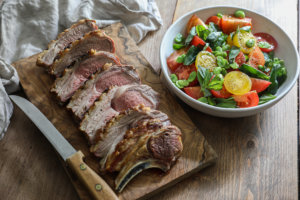
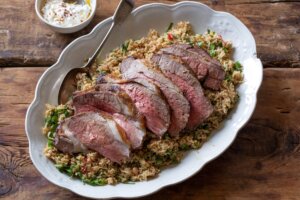
Leg of Lamb with Parsnips, Barley & Cavolo Nero

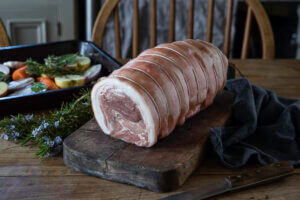
Whole Lamb Leg Recipe: A Classic Roast with a Twist: A whole leg of lamb is one of the most iconic roasting joints, worthy of any celebratory meal. Cooked on the bone with its generous layer of fat, it delivers incredibly juicy, flavourful meat that’s hard to beat.

But perhaps it’s time to shake things up a little? Instead of the usual roast potatoes, why not try something different – something equally satisfying but with a fresh perspective? This recipe pairs roasted parsnips with barley, a wonderfully versatile grain that truly shines when simmered in rich lamb stock. The deep, savoury notes of the lamb enhance the barley’s texture, creating a comforting and wholesome accompaniment.

One crucial element here is balance – a generous splash of high-quality vinegar at the end lifts the dish, cutting through the richness and bringing everything together beautifully. If you’re looking for a new take on a traditional roast, this might just be it.

Serves: 6 (with some lamb for leftovers)

Cook time: 4 hours

Ingredients

For the Lamb Stock

For the Barley

Method

Start with the stock (You may well want to make this a day in advance as it will take a few hours to cook and so relieve you of an extra task on the morning of the day in question)

  1. Preheat your oven to 180°C.
  2. Lay the lamb bones on a roasting tray and place in the oven for 25 minutes.
  3. Remove the tray from the oven and allow to cool slightly before tipping them and their fat into a sensibly sized pot.
  4. Cover with water and bring up to a boil. Turn down to a simmer and leave for 10 minutes.
  5. After 10 minutes, use a ladle to skim off any scum that has formed on the surface.
  6. Add the carrot, onion, garlic and bay leaves.
  7. Allow to simmer very slowly for 3-4 hours, with a lid slightly ajar so not too much liquid evaporates.
  8. Remove from the heat and allow to sit and cool for 30 minutes.
  9. Pass through a sieve and discard the bones and vegetables.

For the lamb:

  1. Remove the lamb leg from the fridge and its packaging and allow to reach room temperature. I would suggest at least 4 hours before cooking.
  2. Preheat your oven to 170°C.
  3. Season the lamb leg well with salt.
  4. In a large roasting tray, lay the parsnips, shallots and a few sprigs of rosemary. Season them with salt, give them a drizzle with olive oil, and give them a little shake.
  5. Place the lamb leg on top and also give this a good drizzle of olive oil.
  6. Place the tray in the oven and set a timer for 45 minutes.
  7. Take the tray out of the oven and turn the parsnips and shallots over, exposing a different side of them to the heat. Also, take this opportunity to baste the lamb leg in some of its own fat and juices.
  8. Return the tray to the oven for another 45 minutes.
  9. Remove the tray and baste a final time before leaving somewhere warm to rest for at least 1 hour.

To make the barley:

  1. Add the butter to a large, heavy-bottomed pan and set it over a medium heat.
  2. Take the stalks of the cavolo nero and finely chop them. Add these, plus the onions and garlic to the pan and season with a pinch of sea salt.
  3. Allow this to cook, stirring regularly, with a lid on, for about 15 minutes. Until it is soft and sweet but not taking on any colour.
  4. Add the barley and stir through the base. Then add the white wine bring to the boil for a moment and then add enough stock to cover the barley by about 2 cm. Season again with a pinch of salt and allow to come to a simmer.
  5. Simmer for about 20-25 minutes, with a slightly ajar lid or a cartouche. If the barley looks too dry at any point, add a splash more stock.
  6. Take the washed cavolo nero leaves and run a knife through them. Add the leaves to the barley and cover with a lid. Cook for 5 minutes, stirring occasionally — the cavolo nero should wilt into the barley.
  7. Grate a little parmesan into the barley to help thicken it slightly and of course, add a little extra depth of flavour.
  8. Check for seasoning and adjust as necessary. As previously stated, adding a good quality white wine vinegar is crucial for me and brings the whole thing to life!
  9. Re-heat the parsnips and shallots and carve the lamb. You are ready to eat.

Order meat online

Instagram

  • British Pie Week, apparently.

We do not usually pay much attention to themed food weeks. We prefer to make and sell things when they feel right.

This year is different, thanks to our growing friendship with Yorkshire chef and pie obsessive Josh Whitehead, and his excellent pie project, Finer Pleasures.

Josh started @finer_pleasures in 2023 to make pies the way they should be made. Proper fillings, local meat and traditional methods.

So we thought we would join in.

The pie is a classic. Chicken, ham, leek and mushroom.

Brined chicken, smoked ham hock and a rich velouté finished with herbs, mustard and chestnut mushrooms or leeks.

A proper pie.

Available this week while they last.
  • It’s easy to become disconnected with the restaurants and kitchens where our meat ends up being prepped, cooked and served. Whilst Instagram can give us a certain understanding of how the food looks; we all know that there is no substitute for experiencing it first-hand. And that is what we had the pleasure of doing this week at the Canton Arms. One of London’s great pubs and one of our oldest, most significant customers. We have been suppling them with exceptional meat since nearly the very beginning of the Swaledale journey. 

Last night was a moment to celebrate that relationship in all its glory; our meat and their cooking and outstanding hospitality coming together for what was a grand evening. We ate, we drank, we chatted in a room that was alive. Long may dining rooms like this thrive and continue to provide people with a space to consume food, booze and hospitality in such a joyous way. 

It was a special night for us, and we hope for everyone who was there. 

Thanks to @chargieb , @cantontrish, @petea25 and the @cantonarms team for being total legends xx

Ps sorry for not getting any decent pics of the food! Was having too much fun.
  • We have all seen the videos. A chicken arrives. Five neat strokes of a knife. It falls apart as if by magic. That comes from thirty years at the block. Most of us do not have that.

So here is a slightly more Radio 4 approach.

A calm, sensible way to take a good chicken and break it down at home. Nothing flashy. Just understanding the joints, working with the bone, and giving each part the respect it deserves. When you do that, you open up a week (almost) of meals. Breasts cooked one way. Legs another. A carcass that becomes stock rather than waste. More on that to follow.

The only things you truly need are a great chicken and a proper knife. Ours is a beautiful honsuki knife kindly supplied by @kitchenprovisions and it does the job expertly. Sharp. Balanced. Delightful.

Watch along as @grylos talks it through.
  • Mutton has earned itself an unfair reputation. For centuries it was simply the meat we ate. Lamb is, in many ways, the modern preference, made possible by refrigeration and global trade. Before that shift, it would have made little sense to slaughter an animal before it had lived fully and bred. Sheep were kept for wool and continuity, and when their working life was complete, they became mutton.

It was part of a cycle. Practical and sustaining. What changed was not the meat, but our habits.

Yet not all mutton is equal. Age alone does not create depth. Mutton reflects the life it has lived. When sheep are kept longer and allowed to graze widely on varied forage, moorland grasses and herbal leys, time and terrain build complexity into the muscle and fat.

That is the mutton we favour and source. Darker, firmer and deeper in flavour, shaped by prolonged grazing on moorland such as this, just outside Skipton.

There was once a rhythm between wool on our backs and mutton on our tables. Perhaps that rhythm still makes sense.
  • Kindred spirits. Hot pans. Spiced mutton.
Swaledale x Canton Arms supper.
Wednesday 25 February.
To book email Thecantonarms@gmail.com

@cantonarms
  • Winter and its cold hands have us fully in a tight embrace right now. And so we find ourselves cooking more often than not, to warm our souls.

A ham at the weekend is one such thing that does the job. It can be used for all kinds of dishes and provide your weekdays with a plethora of fine sandwiches. But this fine cut also produces something else. An excellent, warming stock that should not be thrown away.

In fact, it should be used to make something just as special. A deep, hearty split pea and ham soup. And here is @grylos showing you how to do it. Like most things, if you cook with time and consideration, the by-product is often just as good as the main event.
  • Ask yourself this. When did you last have a really good pork chop?

This is why we keep coming back to it. Native, rare breed pork. Dry aged on the bone. Proper depth of flavour. Nothing like the pale, wet stuff you see elsewhere.

These are our Pork Chops with Rosemary and Anchovy Butter. Two thick, rindless chops. Two discs of handmade compound butter. Anchovy, rosemary, lemon zest, a little shallot. Old friends. It works.
  • Fancy a bit of a butcher’s tip? Or a hack, if you will. Well look no further. 

Here, @grylos, gets creative with a joint of boned and rolled beef rump, creating three, totally different meals, from the one piece of meat. A great example of some leftfield thinking and the perfect way to add a little variety into your weekly meal planning. Along the spectrum from raw to medium, your week could go a little something like this; tartare and toast lightly rubbed with garlic for lunch on Wednesday; steak night on Friday night, with chips, good red wine and a bowl of bearnaise; a roast dinner on Sunday. Bob’s your uncle, Fanny’s your aunt and a carnivorous and hugely satisfying week of eating is complete. 

All that from a single rolled rump of beef! A life hack if I ever saw one…

Did you know that our rumps won 3 stars at the Great Taste Awards? 3-star rump, you can’t argue with that!
British Pie Week, apparently.

We do not usually pay much attention to themed food weeks. We prefer to make and sell things when they feel right.

This year is different, thanks to our growing friendship with Yorkshire chef and pie obsessive Josh Whitehead, and his excellent pie project, Finer Pleasures.

Josh started @finer_pleasures in 2023 to make pies the way they should be made. Proper fillings, local meat and traditional methods.

So we thought we would join in.

The pie is a classic. Chicken, ham, leek and mushroom.

Brined chicken, smoked ham hock and a rich velouté finished with herbs, mustard and chestnut mushrooms or leeks.

A proper pie.

Available this week while they last.
British Pie Week, apparently.

We do not usually pay much attention to themed food weeks. We prefer to make and sell things when they feel right.

This year is different, thanks to our growing friendship with Yorkshire chef and pie obsessive Josh Whitehead, and his excellent pie project, Finer Pleasures.

Josh started @finer_pleasures in 2023 to make pies the way they should be made. Proper fillings, local meat and traditional methods.

So we thought we would join in.

The pie is a classic. Chicken, ham, leek and mushroom.

Brined chicken, smoked ham hock and a rich velouté finished with herbs, mustard and chestnut mushrooms or leeks.

A proper pie.

Available this week while they last.
British Pie Week, apparently.

We do not usually pay much attention to themed food weeks. We prefer to make and sell things when they feel right.

This year is different, thanks to our growing friendship with Yorkshire chef and pie obsessive Josh Whitehead, and his excellent pie project, Finer Pleasures.

Josh started @finer_pleasures in 2023 to make pies the way they should be made. Proper fillings, local meat and traditional methods.

So we thought we would join in.

The pie is a classic. Chicken, ham, leek and mushroom.

Brined chicken, smoked ham hock and a rich velouté finished with herbs, mustard and chestnut mushrooms or leeks.

A proper pie.

Available this week while they last.
British Pie Week, apparently. We do not usually pay much attention to themed food weeks. We prefer to make and sell things when they feel right. This year is different, thanks to our growing friendship with Yorkshire chef and pie obsessive Josh Whitehead, and his excellent pie project, Finer Pleasures. Josh started @finer_pleasures in 2023 to make pies the way they should be made. Proper fillings, local meat and traditional methods. So we thought we would join in. The pie is a classic. Chicken, ham, leek and mushroom. Brined chicken, smoked ham hock and a rich velouté finished with herbs, mustard and chestnut mushrooms or leeks. A proper pie. Available this week while they last.
1 day ago
47
View on Instagram |
1/8
It’s easy to become disconnected with the restaurants and kitchens where our meat ends up being prepped, cooked and served. Whilst Instagram can give us a certain understanding of how the food looks; we all know that there is no substitute for experiencing it first-hand. And that is what we had the pleasure of doing this week at the Canton Arms. One of London’s great pubs and one of our oldest, most significant customers. We have been suppling them with exceptional meat since nearly the very beginning of the Swaledale journey. 

Last night was a moment to celebrate that relationship in all its glory; our meat and their cooking and outstanding hospitality coming together for what was a grand evening. We ate, we drank, we chatted in a room that was alive. Long may dining rooms like this thrive and continue to provide people with a space to consume food, booze and hospitality in such a joyous way. 

It was a special night for us, and we hope for everyone who was there. 

Thanks to @chargieb , @cantontrish, @petea25 and the @cantonarms team for being total legends xx

Ps sorry for not getting any decent pics of the food! Was having too much fun.
It’s easy to become disconnected with the restaurants and kitchens where our meat ends up being prepped, cooked and served. Whilst Instagram can give us a certain understanding of how the food looks; we all know that there is no substitute for experiencing it first-hand. And that is what we had the pleasure of doing this week at the Canton Arms. One of London’s great pubs and one of our oldest, most significant customers. We have been suppling them with exceptional meat since nearly the very beginning of the Swaledale journey. Last night was a moment to celebrate that relationship in all its glory; our meat and their cooking and outstanding hospitality coming together for what was a grand evening. We ate, we drank, we chatted in a room that was alive. Long may dining rooms like this thrive and continue to provide people with a space to consume food, booze and hospitality in such a joyous way. It was a special night for us, and we hope for everyone who was there. Thanks to @chargieb , @cantontrish, @petea25 and the @cantonarms team for being total legends xx Ps sorry for not getting any decent pics of the food! Was having too much fun.
1 week ago
1474
View on Instagram |
2/8
We have all seen the videos. A chicken arrives. Five neat strokes of a knife. It falls apart as if by magic. That comes from thirty years at the block. Most of us do not have that. So here is a slightly more Radio 4 approach. A calm, sensible way to take a good chicken and break it down at home. Nothing flashy. Just understanding the joints, working with the bone, and giving each part the respect it deserves. When you do that, you open up a week (almost) of meals. Breasts cooked one way. Legs another. A carcass that becomes stock rather than waste. More on that to follow. The only things you truly need are a great chicken and a proper knife. Ours is a beautiful honsuki knife kindly supplied by @kitchenprovisions and it does the job expertly. Sharp. Balanced. Delightful. Watch along as @grylos talks it through.
2 weeks ago
611
View on Instagram |
3/8
Mutton has earned itself an unfair reputation. For centuries it was simply the meat we ate. Lamb is, in many ways, the modern preference, made possible by refrigeration and global trade. Before that shift, it would have made little sense to slaughter an animal before it had lived fully and bred. Sheep were kept for wool and continuity, and when their working life was complete, they became mutton.

It was part of a cycle. Practical and sustaining. What changed was not the meat, but our habits.

Yet not all mutton is equal. Age alone does not create depth. Mutton reflects the life it has lived. When sheep are kept longer and allowed to graze widely on varied forage, moorland grasses and herbal leys, time and terrain build complexity into the muscle and fat.

That is the mutton we favour and source. Darker, firmer and deeper in flavour, shaped by prolonged grazing on moorland such as this, just outside Skipton.

There was once a rhythm between wool on our backs and mutton on our tables. Perhaps that rhythm still makes sense.
Mutton has earned itself an unfair reputation. For centuries it was simply the meat we ate. Lamb is, in many ways, the modern preference, made possible by refrigeration and global trade. Before that shift, it would have made little sense to slaughter an animal before it had lived fully and bred. Sheep were kept for wool and continuity, and when their working life was complete, they became mutton.

It was part of a cycle. Practical and sustaining. What changed was not the meat, but our habits.

Yet not all mutton is equal. Age alone does not create depth. Mutton reflects the life it has lived. When sheep are kept longer and allowed to graze widely on varied forage, moorland grasses and herbal leys, time and terrain build complexity into the muscle and fat.

That is the mutton we favour and source. Darker, firmer and deeper in flavour, shaped by prolonged grazing on moorland such as this, just outside Skipton.

There was once a rhythm between wool on our backs and mutton on our tables. Perhaps that rhythm still makes sense.
Mutton has earned itself an unfair reputation. For centuries it was simply the meat we ate. Lamb is, in many ways, the modern preference, made possible by refrigeration and global trade. Before that shift, it would have made little sense to slaughter an animal before it had lived fully and bred. Sheep were kept for wool and continuity, and when their working life was complete, they became mutton.

It was part of a cycle. Practical and sustaining. What changed was not the meat, but our habits.

Yet not all mutton is equal. Age alone does not create depth. Mutton reflects the life it has lived. When sheep are kept longer and allowed to graze widely on varied forage, moorland grasses and herbal leys, time and terrain build complexity into the muscle and fat.

That is the mutton we favour and source. Darker, firmer and deeper in flavour, shaped by prolonged grazing on moorland such as this, just outside Skipton.

There was once a rhythm between wool on our backs and mutton on our tables. Perhaps that rhythm still makes sense.
Mutton has earned itself an unfair reputation. For centuries it was simply the meat we ate. Lamb is, in many ways, the modern preference, made possible by refrigeration and global trade. Before that shift, it would have made little sense to slaughter an animal before it had lived fully and bred. Sheep were kept for wool and continuity, and when their working life was complete, they became mutton.

It was part of a cycle. Practical and sustaining. What changed was not the meat, but our habits.

Yet not all mutton is equal. Age alone does not create depth. Mutton reflects the life it has lived. When sheep are kept longer and allowed to graze widely on varied forage, moorland grasses and herbal leys, time and terrain build complexity into the muscle and fat.

That is the mutton we favour and source. Darker, firmer and deeper in flavour, shaped by prolonged grazing on moorland such as this, just outside Skipton.

There was once a rhythm between wool on our backs and mutton on our tables. Perhaps that rhythm still makes sense.
Mutton has earned itself an unfair reputation. For centuries it was simply the meat we ate. Lamb is, in many ways, the modern preference, made possible by refrigeration and global trade. Before that shift, it would have made little sense to slaughter an animal before it had lived fully and bred. Sheep were kept for wool and continuity, and when their working life was complete, they became mutton. It was part of a cycle. Practical and sustaining. What changed was not the meat, but our habits. Yet not all mutton is equal. Age alone does not create depth. Mutton reflects the life it has lived. When sheep are kept longer and allowed to graze widely on varied forage, moorland grasses and herbal leys, time and terrain build complexity into the muscle and fat. That is the mutton we favour and source. Darker, firmer and deeper in flavour, shaped by prolonged grazing on moorland such as this, just outside Skipton. There was once a rhythm between wool on our backs and mutton on our tables. Perhaps that rhythm still makes sense.
3 weeks ago
501
View on Instagram |
4/8
Kindred spirits. Hot pans. Spiced mutton. Swaledale x Canton Arms supper. Wednesday 25 February. To book email Thecantonarms@gmail.com @cantonarms
3 weeks ago
1526
View on Instagram |
5/8
Winter and its cold hands have us fully in a tight embrace right now. And so we find ourselves cooking more often than not, to warm our souls. A ham at the weekend is one such thing that does the job. It can be used for all kinds of dishes and provide your weekdays with a plethora of fine sandwiches. But this fine cut also produces something else. An excellent, warming stock that should not be thrown away. In fact, it should be used to make something just as special. A deep, hearty split pea and ham soup. And here is @grylos showing you how to do it. Like most things, if you cook with time and consideration, the by-product is often just as good as the main event.
4 weeks ago
14516
View on Instagram |
6/8
Ask yourself this. When did you last have a really good pork chop?

This is why we keep coming back to it. Native, rare breed pork. Dry aged on the bone. Proper depth of flavour. Nothing like the pale, wet stuff you see elsewhere.

These are our Pork Chops with Rosemary and Anchovy Butter. Two thick, rindless chops. Two discs of handmade compound butter. Anchovy, rosemary, lemon zest, a little shallot. Old friends. It works.
Ask yourself this. When did you last have a really good pork chop?

This is why we keep coming back to it. Native, rare breed pork. Dry aged on the bone. Proper depth of flavour. Nothing like the pale, wet stuff you see elsewhere.

These are our Pork Chops with Rosemary and Anchovy Butter. Two thick, rindless chops. Two discs of handmade compound butter. Anchovy, rosemary, lemon zest, a little shallot. Old friends. It works.
Ask yourself this. When did you last have a really good pork chop? This is why we keep coming back to it. Native, rare breed pork. Dry aged on the bone. Proper depth of flavour. Nothing like the pale, wet stuff you see elsewhere. These are our Pork Chops with Rosemary and Anchovy Butter. Two thick, rindless chops. Two discs of handmade compound butter. Anchovy, rosemary, lemon zest, a little shallot. Old friends. It works.
1 month ago
472
View on Instagram |
7/8
Fancy a bit of a butcher’s tip? Or a hack, if you will. Well look no further. Here, @grylos, gets creative with a joint of boned and rolled beef rump, creating three, totally different meals, from the one piece of meat. A great example of some leftfield thinking and the perfect way to add a little variety into your weekly meal planning. Along the spectrum from raw to medium, your week could go a little something like this; tartare and toast lightly rubbed with garlic for lunch on Wednesday; steak night on Friday night, with chips, good red wine and a bowl of bearnaise; a roast dinner on Sunday. Bob’s your uncle, Fanny’s your aunt and a carnivorous and hugely satisfying week of eating is complete. All that from a single rolled rump of beef! A life hack if I ever saw one… Did you know that our rumps won 3 stars at the Great Taste Awards? 3-star rump, you can’t argue with that!
1 month ago
2585
View on Instagram |
8/8